
Root cause analysis — from the symptom of an event to what actually caused it

Repeating events usually mean the previous investigation stopped at human error. This module walks the team through structured RCA techniques and makes sure every finding becomes a concrete action.

  • 5 Why
  • Ishikawa
  • Bow Tie
  • ISO 45001
  • Barrier analysis
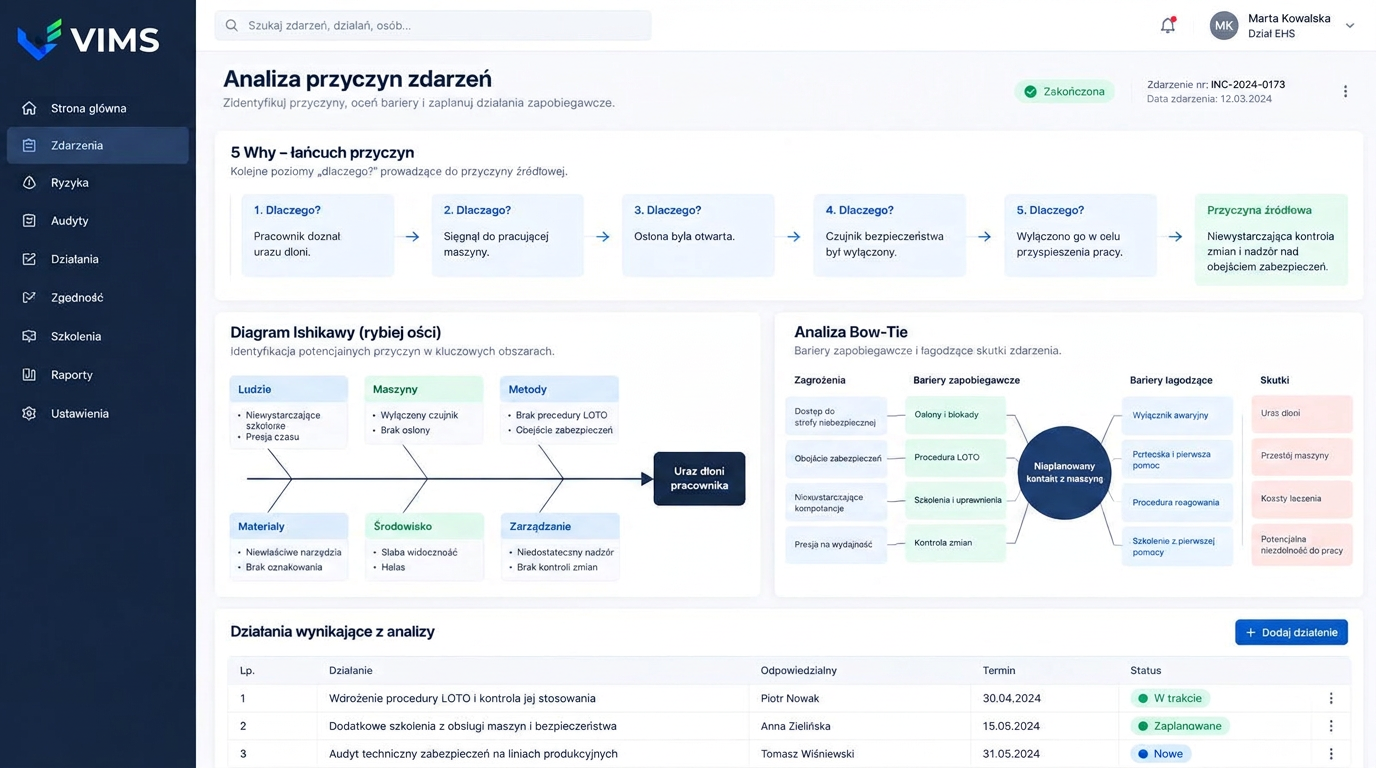
VIMS — root cause analysis module showing a 5 Why chain, Ishikawa fishbone diagram, Bow Tie barrier analysis and resulting corrective actions

Why most investigations end in the same place

In many plants the investigation file closes with a sentence about inattention or failure to follow the instruction. It satisfies the formality but changes nothing in how work is organised. A few months later a very similar event appears on the next line, on another shift or on another job, and the whole procedure starts again.

The reason is simple: an investigation run in a hurry, in a spreadsheet or a text document, has no frame that forces the team one level deeper. Nobody asks why the guard was open, why schedule pressure outweighed safety pressure, why the process change was never reviewed and why nobody spotted it earlier.

The VIMS analysis module brings that frame into the daily work of safety, quality and maintenance teams. The analysis lives inside the event record rather than in a separate file, so the description, photos, witness statements and conclusions stay in one context for the whole investigation.

Four techniques matched to the scale of the event

Not every event needs a full analytical workshop. A minor near miss is closed by a short 5 Why chain completed by a shift leader in minutes. A serious accident, a failure with environmental risk or a customer complaint calls for teamwork and a wider view.

The 5 Why method builds a linear chain of questions until the answer concerns the management system rather than one person's behaviour. The Ishikawa diagram organises candidate causes into people, machines, methods, materials, environment and management, so the team does not fixate on the most visible element.

Bow Tie analysis shows the central event with preventive barriers on the left and mitigating barriers on the right. It is the clearest way to explain to management which barrier failed, which held and where the organisation has no protection at all. A full RCA combines these approaches and documents the entire path to the root cause.

What the Root cause analysis module gives you

5 Why chain

Successive levels of questioning with a visible path from symptom to root cause and a clearly marked end point.

Ishikawa diagram

Causes grouped into people, machines, methods, materials, environment and management, with custom branches where needed.

Bow Tie and barrier analysis

Preventive and mitigating barriers mapped around the central event, with an assessment of which ones failed.

Team collaboration

Analysis team, roles, workshop notes and change history stored with the event.

Findings turned into actions

Every identified cause can create a corrective action with an owner and a due date straight away.

Recurring causes

A view of the most frequent root causes by area, production line and event type.

Where analysis sits in the whole event workflow

Root cause analysis is the link between a report and an effective action, not a separate administrative stage.

  1. 1Event reported and classified
  2. 2Facts and evidence gathered
  3. 3Analysis technique selected
  4. 4Root cause established
  5. 5Corrective actions created
  6. 6Risk assessment and barriers updated

Analysis that does not end with a document

The value of an investigation is the decision that follows it, not the diagram itself. In VIMS each identified cause can become a corrective or preventive action without retyping data into another table. The action inherits the context: event number, location, cause description and rationale.

At the management review you can therefore show not only how many analyses were completed, but what share of them actually led to a change: a LOTO procedure, a modified guard, a revised inspection schedule or additional on-the-job training.

If the analysis shows that the existing risk assessment never covered the scenario, the module points the user to the job risk assessment record. A finding from a single event reaches the document that genuinely drives prevention.

Who uses the module day to day

Safety specialists investigate accidents and near misses with a ready structure instead of an empty document. Quality teams analyse process nonconformities and complaints using the same techniques, since Ishikawa and 5 Why are standard in both safety and quality systems.

Maintenance uses barrier analysis for critical machine failures to separate technical causes from organisational ones. Production managers see which actions from investigations fall on their team and when they are due.

Frequently asked questions about root cause analysis

What is the difference between an immediate and a root cause?

The immediate cause is what happened just before the outcome, for example contact with a moving part. The root cause sits in the management system: missing change control, an outdated instruction or supervision that never detected a bypassed guard. Removing only the immediate cause rarely prevents a repeat.

Do I always have to ask exactly five whys?

No. Five is indicative. You stop when the next answer falls outside the organisation's control. Sometimes three levels are enough, sometimes seven are needed.

Can several people work on one analysis?

Yes. A team is assigned to the analysis and the change history shows who added each cause or conclusion and when.

What happens to the findings once the analysis is closed?

They become corrective and preventive actions with an owner, a due date and a status. The analysis stays linked to the original event and to the actions created from it.

Does the module also fit quality nonconformities?

Yes. The same techniques apply to complaints, process nonconformities and deviations found during internal audits.

Related modules

VIMS module

Report an event in seconds, run the root cause analysis, plan actions and close the case with complete documentation in one place.

Accidents and incidents

VIMS module

No more action lists in a spreadsheet. Every action has an owner, a deadline, a status and an effectiveness check — all in one view.

CAPA

VIMS module

Run risk assessment online: hazards, risk levels, control measures and reviews in one place, connected to what actually happens on site.

Risk assessment

See root cause analysis in VIMS

Book a demo and let us walk through a complete analysis using an event from your own plant.