
Risk assessment — a living document instead of a binder

Run risk assessment online: hazards, risk levels, control measures and reviews in one place, connected to what actually happens on site.

  • Risk assessment
  • ISO 45001
  • Control measures
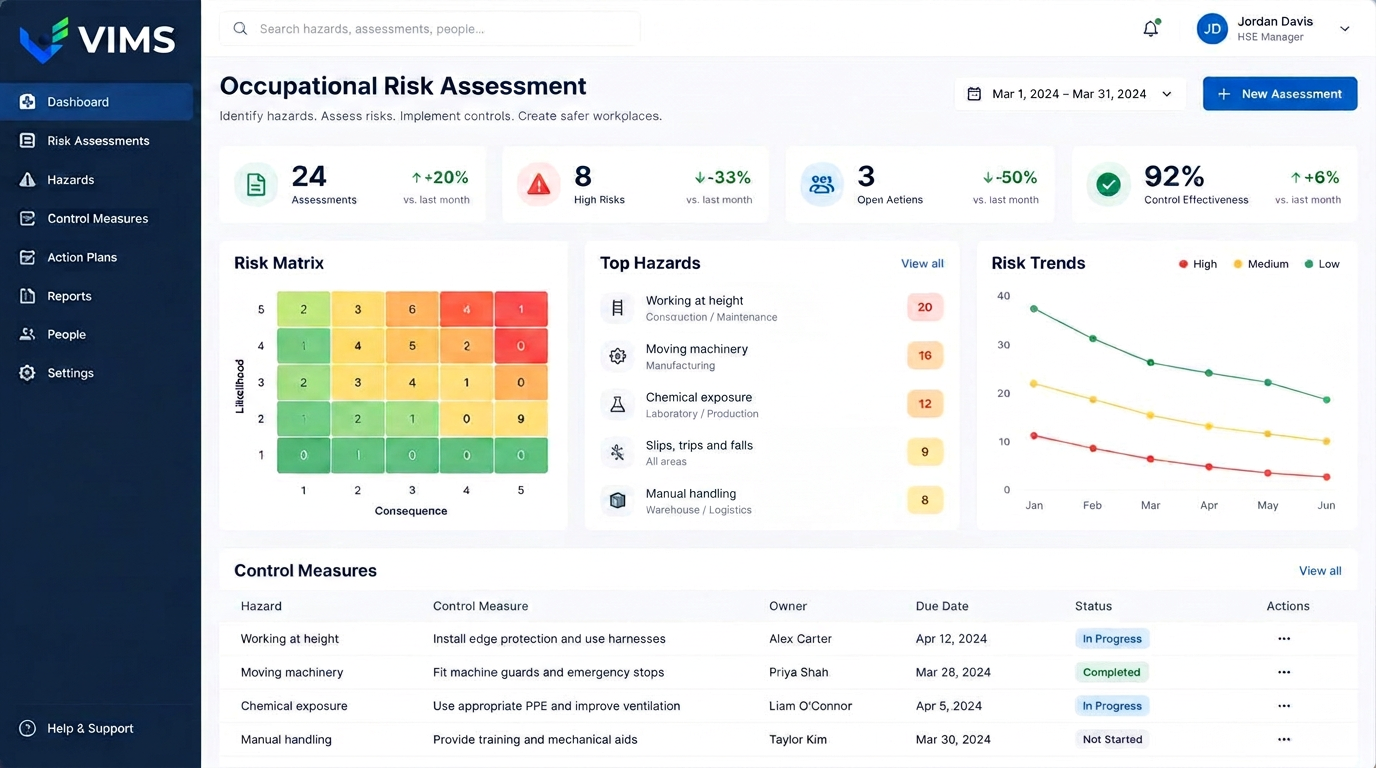
VIMS — occupational risk assessment software showing the risk matrix, hazard register and control measures with owners

A risk assessment nobody reads protects nobody

A typical occupational risk assessment is written once, signed by employees and filed. Two years later it describes a job whose equipment, work organisation and staffing have all changed. The document formally exists but no longer reflects reality and influences no decisions.

The second common problem is the disconnect from events. An accident happens, a report is written, actions are assigned, and the job risk assessment stays untouched. The scenario that just materialised is still not in it.

The VIMS risk module treats the assessment as a living document. Hazards, risk levels and controls are editable, carry a change history and review reminders, and findings from accidents and inspections can flow straight back into the right record.

Method and a readable risk matrix

The assessment rests on two dimensions: how likely an event is and how severe its consequences could be. Their combination gives a risk level that sets the urgency of action. What matters most, though, is the distinction between risk before controls and risk after them.

Inherent risk shows how dangerous the job would be with no safeguards. Residual risk describes what employees actually face. If both levels are identical, the planned controls either change nothing or were never implemented.

The hierarchy of controls has a strict order: eliminate the hazard, substitute something less dangerous, engineering controls, organisational measures and only then personal protective equipment. VIMS lets you tag the type of each control, so it is visible whether the plant genuinely reduces hazards or mostly hands out gloves.

What the Risk assessment module gives you

Hazard register

Hazards linked to jobs, areas and processes, with description and source.

Risk matrix

Likelihood and consequence scoring with clear risk levels before and after actions.

Control measures

Technical, organizational and personal protection measures in one list.

Periodic reviews

Reminders to update the assessment and a full history of changes.

Linked to events

Findings from accidents and reports flow back into the assessment instead of getting lost.

Overview and reports

Risk summaries by area and status, ready for management review.

How risk assessment connects to the rest of VIMS

The assessment is not a shelf document — it drives actions and returns after every significant change.

  1. 1Hazard identified
  2. 2Risk level scored
  3. 3Control measures
  4. 4CAPA actions
  5. 5Effectiveness check
  6. 6Assessment updated

When the assessment has to be updated

A periodic review is the minimum. In practice updates are needed far more often: a change of technology, a new machine, reorganised work, a new chemical, after an accident or a serious near miss, and following recommendations from an inspection body.

VIMS reminds you about upcoming reviews and shows which records have gone longest without an update. It is a simple way to catch areas that slipped out of view.

The change history lets you show an auditor not only the current version but the path of its development, with the reasoning behind each revision.

Risk assessment as a planning tool, not just a document

Listing all records by residual risk gives management an investment priority list. It shows where risk stays high despite the measures applied and where technical change is needed rather than another instruction.

Controls awaiting implementation can become actions with an owner and a deadline, so the assessment actually generates work instead of merely describing a state.

The assessment record is also the natural source of on-the-job training scope and of the protective equipment required for a given task.

Frequently asked questions

Can I assess both jobs and areas?

Yes. Hazards can be assigned to jobs, areas, processes or specific tasks.

Does the system show risk before and after actions?

Yes. Each hazard shows its initial risk level and the level after control measures.

Does the assessment update after an incident?

Findings from events and CAPA actions can be carried into the assessment so real site knowledge returns to it.

Can review deadlines be tracked?

Yes. The system tracks review dates and notifies the people responsible.

Related modules

VIMS module

Report an event in seconds, run the root cause analysis, plan actions and close the case with complete documentation in one place.

Accidents and incidents

Hazard reporting

The cheapest information in a plant is the one that arrives before an accident. This module shortens the path from spotting a hazard to deciding on an action, and makes sure the reporter hears back.

Hazard reporting

VIMS module

One substance register, current safety data sheets available from a phone and full control over what is used where on site.

Chemicals and SDS

See risk assessment in VIMS

Book a demo and see risk assessment run continuously instead of once a year.