
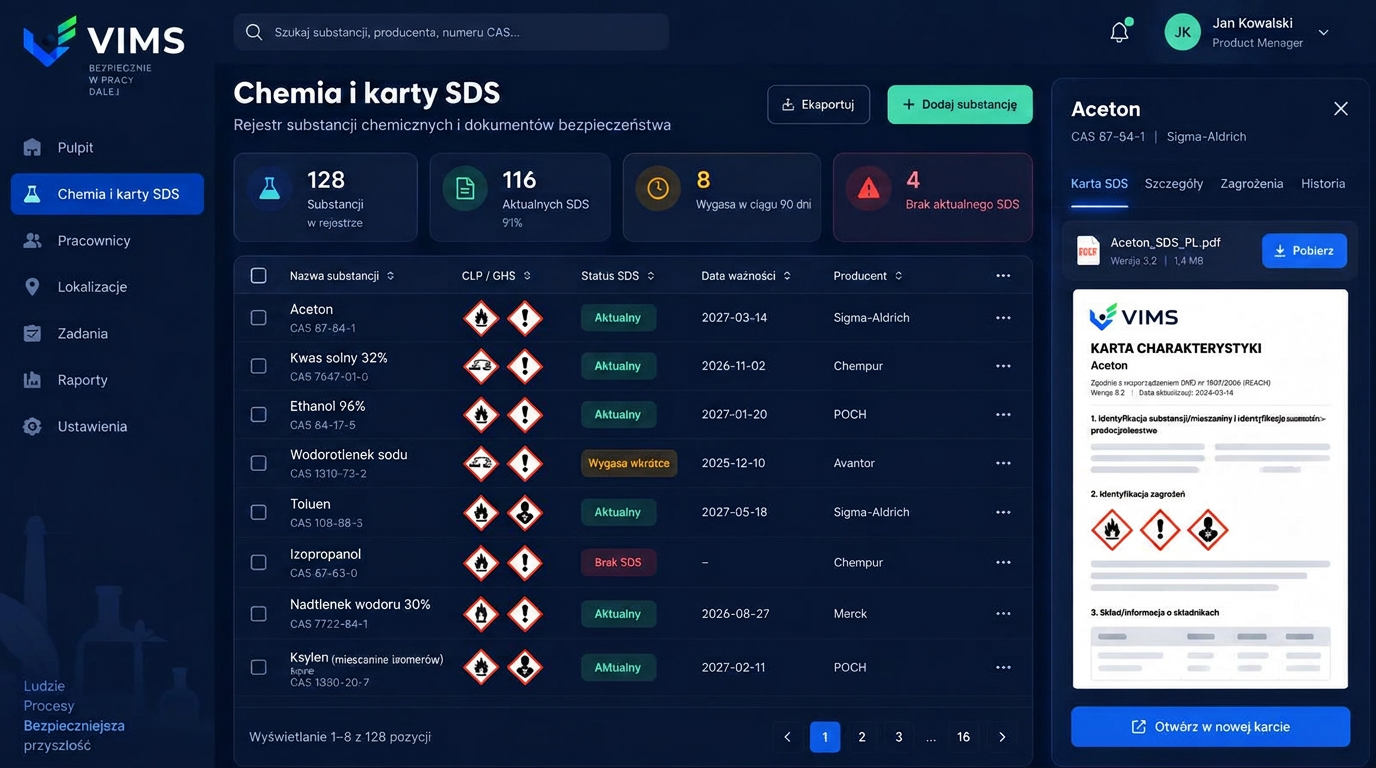
Chemicals and SDS — a live substance register instead of a binder

One substance register, current safety data sheets available from a phone and full control over what is used where on site.

  • REACH
  • CLP / GHS
  • Safety data sheets
VIMS — chemical register and SDS management software with CLP/GHS hazard pictograms and document expiry control

A binder of safety data sheets is a safety fiction

Formally the sheets are available, because they sit in a binder in the supervisor's office. In practice nobody reaches for them, since skin contact or a spill is a matter of seconds, not a walk across the hall. On top of that, some sheets are years old while the supplier has changed the formulation or the classification.

Then there is the inventory problem. Substances enter the plant through purchasing, maintenance, the laboratory and contractors. Without one register nobody can say how many different products are actually in use, in what quantities and in which zones they are stored.

The VIMS chemicals module keeps a live register of substances and mixtures. Each entry carries the manufacturer, CAS or EC number, classification, place of use, approximate quantities and a current safety data sheet available from a phone at the point of work.

CLP classification translated into daily decisions

Pictograms, hazard statements and precautionary statements are not label decoration. They determine glove selection, ventilation requirements, storage rules, incompatibility with other substances and the scope of first aid.

In VIMS that information is stored against the substance in a structured form, not only inside a PDF. You can therefore search the register for substances with a given hazard, for example carcinogenic or reprotoxic ones, and see where they are used.

Such a review is the starting point for chemical risk assessment and for a substitution programme. Without a classified register the subject stays at the level of declarations.

What the Chemicals and SDS module gives you

Substance register

Name, manufacturer, CAS number, place of use and quantities in one list.

Safety data sheets

Current SDS documents linked to each substance, available from a phone or QR code.

CLP and GHS classification

Hazard pictograms, H and P statements and required personal protective equipment.

Expiry control

Alerts for missing and outdated sheets before an inspector notices them.

Access at the workplace

Workers check the sheet and handling rules right where the substance is used.

Lists and reports

Substance inventories for inspections, audits and chemical risk assessment.

Chemicals connected to other processes

A substance is not just a row in a table — it feeds risk assessment, training and actions.

  1. 1Substance added
  2. 2CLP classification
  3. 3SDS and protective measures
  4. 4Chemical risk assessment
  5. 5Training and instructions
  6. 6Review and update

Point-of-use access through a QR code

A code on the chemical store or at the workstation opens the right substance card on a phone: pictograms, required protection, spill response and first aid. The worker does not have to recall a trade name or hunt for a paper copy.

It also has a training dimension. On-the-job instruction stops being a one-off conversation, because the information is there when it is needed.

During an inspection you can show in seconds that the sheets are current and genuinely available to workers, not merely filed in an office.

Chemicals linked to risk assessment and training

Introducing a new substance should trigger a chain of decisions: checking for a safer alternative, updating the risk assessment for the affected jobs, verifying protective measures, revising instructions and informing employees.

In VIMS a substance is not an isolated entry. From its record you can move to the job risk assessment, to the required training and to actions if a review found gaps.

When the supplier publishes a new version of the sheet, the change is recorded with a date, so the documentation history of each substance on site is visible.

Frequently asked questions

Can workers open an SDS on the shop floor?

Yes. The sheet opens on a phone after scanning a QR code at the workstation or chemical store.

Does the system track SDS validity?

Yes. VIMS flags missing and outdated sheets and reminds you to obtain the latest version from the supplier.

Does the register support CLP classification?

Yes. Each substance carries its pictograms, H and P statements and required protective equipment.

Can I produce a substance list for an inspection?

Yes. A list broken down by location and hazard can be generated in moments.

Take control of chemicals on site

Book a demo and see the substance register and SDS workflow applied to your organization.