
VariloVIMS

VIMS for multi-site groups — comparability instead of collected reports

A group head office rarely lacks data; it lacks comparability. Every plant counts incidents differently, classifies nonconformities differently and reads 'action closed' differently. Stacking those numbers produces a report nobody uses for decisions. VIMS solves this at the level of process definition rather than report templates.

  • One standard
  • Comparable KPIs
  • Role model
  • Action oversight
  • Cross audits
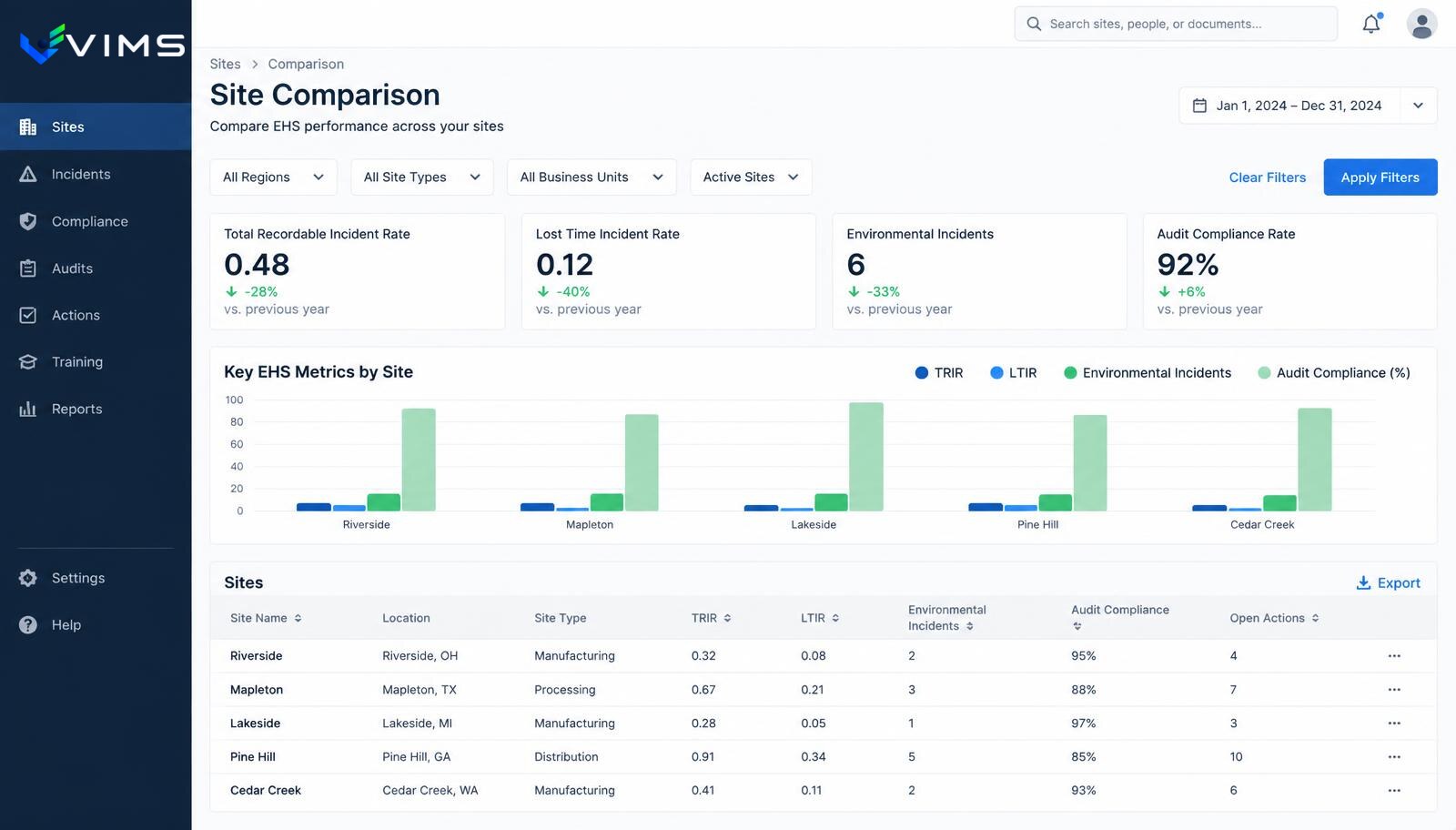
V-IMS — multi-site dashboard: EHS indicator comparison across plants, grouped bar chart for five locations and a table with audits and open actions

Why a consolidated report is not yet comparability

When head office asks plants for indicators, the numbers arrive on time. The trouble starts with interpretation: plant A records every cut, plant B only cases needing medical treatment, and plant C keeps two registers because that was easier after a merger.

The same applies to corrective actions. 'Closed' means 'done and verified' in one plant and 'handed over for execution' in another. A CAPA timeliness indicator then compares two different things.

The third dimension is audits. If each plant uses its own question set, 92% here and 78% there says nothing about the difference in safety — it describes a difference in questions.

A shared process definition as the condition for comparison

VIMS bases comparability on the process having the same structure everywhere: the same event types, the same action stages, the same closure condition. A plant may keep its own checklists and extra categories, but the skeleton stays common.

Head office therefore stops collecting reports and simply views the same data set from another angle. The plant sees its actions, the region sees its plants, the board sees the group.

The second benefit is transferring solutions. If root cause analysis in one plant led to an effective technical change, the same item can become a preventive action elsewhere — without waiting for the event to repeat.

What multiple locations actually need

Organisational structure

Group, region, plant, department — every record belongs to a level, so reporting at any cut needs no manual aggregation.

Plant comparison

Incident, action timeliness and inspection completion indicators compared across locations on shared definitions.

Standard with local room

Common process types and stages, with the option to add local checklists and categories where it makes sense.

Cross audits

An audit run by a team from another plant, with findings landing in the shared action register.

Group-wide preventive actions

A conclusion from one incident can be assigned as a preventive action in the remaining locations.

Roles and data visibility

A permission model where a plant manager sees their own data and head office sees the group view, without mixing scopes.

How information travels in a group

From an incident in one plant to a preventive action in the rest.

  1. 1Incident at a plant
  2. 2Local analysis
  3. 3Corrective action
  4. 4Group-level conclusion
  5. 5Review at other plants
  6. 6Preventive action
  7. 7Implementation check
  8. 8Management review

Modules used in this industry

The starting set follows the processes that generate the most work and the most risk in this environment.

VIMS module

Plan an audit or round, run it from a phone, record nonconformities and launch actions immediately — without retyping results into a spreadsheet.

Explore the module

VIMS module

Report an event in seconds, run the root cause analysis, plan actions and close the case with complete documentation in one place.

Explore the module

VIMS module

No more action lists in a spreadsheet. Every action has an owner, a deadline, a status and an effectiveness check — all in one view.

Explore the module

Root cause analysis

Repeating events usually mean the previous investigation stopped at human error. This module walks the team through structured RCA techniques and makes sure every finding becomes a concrete action.

Explore the module

VIMS module

Run risk assessment online: hazards, risk levels, control measures and reviews in one place, connected to what actually happens on site.

Explore the module

VIMS module

See in one view who holds valid training and qualifications, whose certificates expire soon and what is missing for a given job.

Explore the module

Rounds and inspections

A safety walkaround is a cheap prevention tool, but only when it happens regularly and ends with an assigned task. This module enforces both conditions.

Explore the module

Employees and competence

The same people appear on the training list, in the examination schedule, in a risk assessment, on a work permit and in an accident report. If each of those lists lives its own life, sooner or later they stop agreeing. This module fixes the problem at the data level, not at the form level.

Explore the module

Group rollout: why a single-plant pilot can mislead

A pilot in one location is operationally sensible but misleading if that plant is the best organised. Conclusions do not transfer to sites where base data is in worse shape.

A more practical approach is to pick two locations of different maturity and set the standard from the harder one. A standard that works in poor conditions will work in good ones.

Decide upfront what is common and what is local. Skipping that decision produces eighteen variants of the same process — exactly what the group wanted to leave behind.

Indicators that actually change something

Lagging indicators such as accident counts describe the past and are statistically unstable for small plants. A year without an accident at a fifty-person site proves only that nothing happened.

Leading indicators — report volume, inspection plan completion, action timeliness, participation in safety talks — are less dramatic but controllable and comparable across sites of different size.

VIMS exposes both, but a meaningful management review in a group usually rests on the leading set, with lagging figures as background.

Questions from multi-site organisations

Can each plant keep its own checklists?

Yes. The process structure and status definitions stay shared, while question sets and local categories may differ.

Does head office see plant employees' personal data?

Visibility follows the role model agreed at rollout. Typically head office works on aggregated views while HR data stays local.

How long does harmonising several plants take?

It depends mainly on the state of base data, not the number of locations. A plant with tidy employee and asset registers deploys far faster.

Can plants of different size be compared?

Yes, provided indicators are normalised by headcount or hours worked and complemented by leading indicators, which are less sensitive to scale.

Are cross audits between plants supported?

Yes. An auditor from another location runs the audit against the shared question set, and findings go to the audited plant's action register.

Other industries

Industry: manufacturing and heavy industry

See

Industry: food industry and FMCG

See

Industry: logistics, warehousing and distribution

See

Industry: construction and contracting

See

Industry: EHS consultancies and outsourced safety services

See

Let us discuss a standard for the whole group

We will show how to set a shared process skeleton without stripping plants of local specifics.