
VariloVIMS

VIMS for warehouses — traffic, equipment and qualifications under control

A warehouse is an environment where risk comes mainly from movement: trucks, people, pallets and time. Incidents are rarely spectacular — more often a series of minor collisions, damaged racking uprights and situations that almost happened. The value of a system here is not documenting accidents but collecting signals before one occurs.

  • Forklift checks
  • Racking inspections
  • Near misses
  • Operator licences
  • Shift briefings
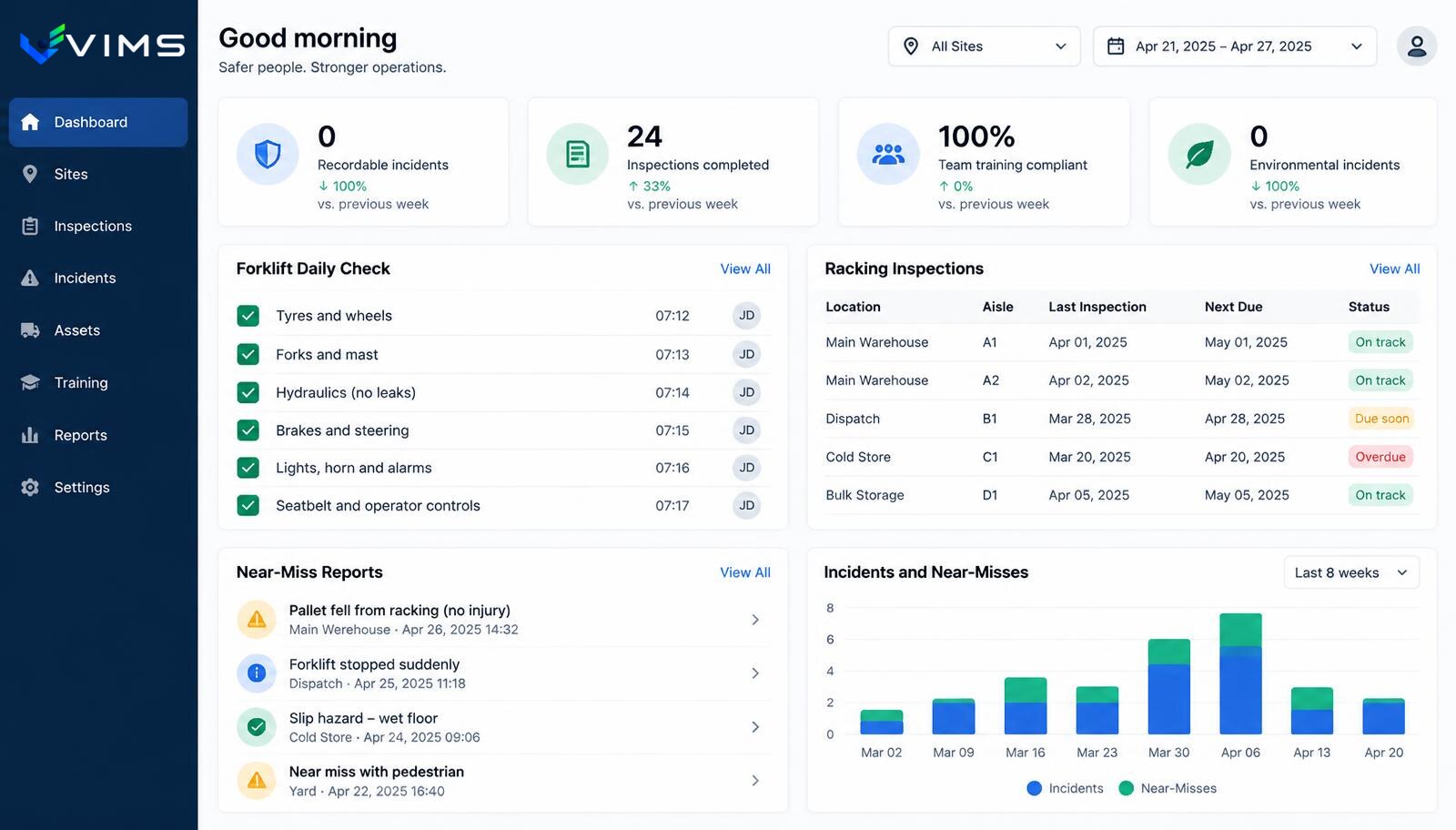
V-IMS — warehouse dashboard: daily forklift check list, racking inspection table with due dates, near-miss report feed and a weekly chart

In a warehouse the danger is what never gets reported

A damaged racking upright rarely causes immediate consequences. A driver clips a post, judges it trivial and moves on because there is a dispatch plan. Weeks later that section carries a different load and the consequences can be serious, though nobody links them to that moment.

Qualifications behave the same way. An operator covering a colleague on a different truck type usually manages technically but formally has no confirmed training for that model. The information exists in an HR binder, not where the work is assigned.

The third factor is turnover. In distribution centres the shift roster changes seasonally, and so does experience. Without a record of training and inductions it is hard to judge whether December's night shift is as prepared as September's day shift.

A system that rewards reporting small things

Prevention in a warehouse depends on the cost of reporting. If a report means filling in a paper form in the manager's office, the number of reports will be near zero and the statistics will look excellent until the first serious event.

In VIMS a report takes under a minute on a phone: photo, location, short description. Classification and the decision to act belong to the supervisor, so employees are not asked to qualify the event.

After a few weeks the visible result is a map of places where something repeats: a specific aisle, a specific ramp, a specific hour. That is enough detail to redesign traffic flow rather than issue another reminder to be careful.

Features shaped around warehouse work

Equipment checks via QR code

An operator scans the truck or checkpoint and completes a short checklist before starting work, without going to the office.

Racking and infrastructure inspections

A register of racking, doors, ramps and equipment with inspection dates and remarks turned into repair tasks.

Near-miss reporting

A fast phone report with location and photo for situations that caused no harm but could have.

Operator qualifications

Training and licence status by equipment type, visible before a task is assigned rather than after an inspection.

Area inspections

Walks of aisles, picking zones and the yard, with checklists matched to the area.

Shift briefings and talks

A register of short safety talks with topic, participants and attendance confirmation.

A typical distribution centre flow

From the pre-shift check to a permanent change in traffic organisation.

  1. 1Pre-shift check
  2. 2Defect report
  3. 3Equipment withdrawn
  4. 4Repair and release
  5. 5Near miss
  6. 6Pattern analysis
  7. 7Layout change
  8. 8Shift briefing

Modules used in this industry

The starting set follows the processes that generate the most work and the most risk in this environment.

Registers and inspections

A plant runs a dozen parallel registers: cranes, pressure vessels, forklifts, extinguishers, hydrants, electrical installations, ladders, hoists, gates. Each has its own cycle and its own owner. This module brings them into one register with one calendar.

Explore the module

Rounds and inspections

A safety walkaround is a cheap prevention tool, but only when it happens regularly and ends with an assigned task. This module enforces both conditions.

Explore the module

Hazard reporting

The cheapest information in a plant is the one that arrives before an accident. This module shortens the path from spotting a hazard to deciding on an action, and makes sure the reporter hears back.

Explore the module

VIMS module

See in one view who holds valid training and qualifications, whose certificates expire soon and what is missing for a given job.

Explore the module

VIMS module

Report an event in seconds, run the root cause analysis, plan actions and close the case with complete documentation in one place.

Explore the module

LMRA

A job risk assessment describes a workplace under typical conditions. LMRA answers a different question: is this work safe here, right now, with this crew?

Explore the module

VIMS module

No more action lists in a spreadsheet. Every action has an owner, a deadline, a status and an effectiveness check — all in one view.

Explore the module

Safety conversations

Few workers fill in a form to say that a guard gets in the way or that a procedure is unrealistic at the current pace. They will say it in a short conversation at the machine. This module structures those conversations and turns them into usable knowledge.

Explore the module

Equipment that reminds you about its own inspection

Warehouse equipment works hard and its inspection is often treated as a formality. A daily truck checklist only makes sense if the result goes somewhere and a negative answer actually triggers something.

In VIMS, flagging a defect during a check creates a task for the technical team and marks the equipment as needing attention. The shift supervisor sees that before assigning the truck, not after a breakdown.

Check history stays with the individual unit, so cost reviews reveal which machines generate the most defects — usually an argument for replacement rather than another repair.

Peak season as a stress test for processes

Q4 in logistics means more people, more hours and less time for paperwork. That is when paper-based processes fail, simply because nobody has time to service them.

Processes built from short mobile actions carry the load better: an induction is a checklist rather than a meeting, and the briefing attendance record is created in the same minute as the briefing.

After the season a comparison remains: reports, incidents and completed checks inside and outside peak. That is the most reliable input for planning staffing and induction scope next year.

Questions from logistics operators

Can a truck check be done without logging into the system?

Access scope is set by the organisation. A common scenario is scanning a code on the equipment and completing a short mobile form linked to the operator's account.

Does the system support several warehouses at once?

Yes. Objects and events belong to a location, so data can be viewed per site or aggregated across the network.

What about agency workers?

Non-payroll staff are kept in a record with their own set of required documents and inductions, which shows who may operate specific equipment.

Can racking inspections be registered?

Yes, in the object register with dates, reports and remarks. A remark can immediately create a dated repair task.

How do we get the team to report minor situations?

A short form and visible follow-up work best. When reporters see the status and the action taken, volume grows without poster campaigns.

Other industries

Industry: manufacturing and heavy industry

See

Industry: food industry and FMCG

See

Industry: construction and contracting

See

Industry: multi-site organisations

See

Industry: EHS consultancies and outsourced safety services

See

See VIMS on your warehouse layout

We will walk the path from a pre-shift check to a change in aisle traffic together.