
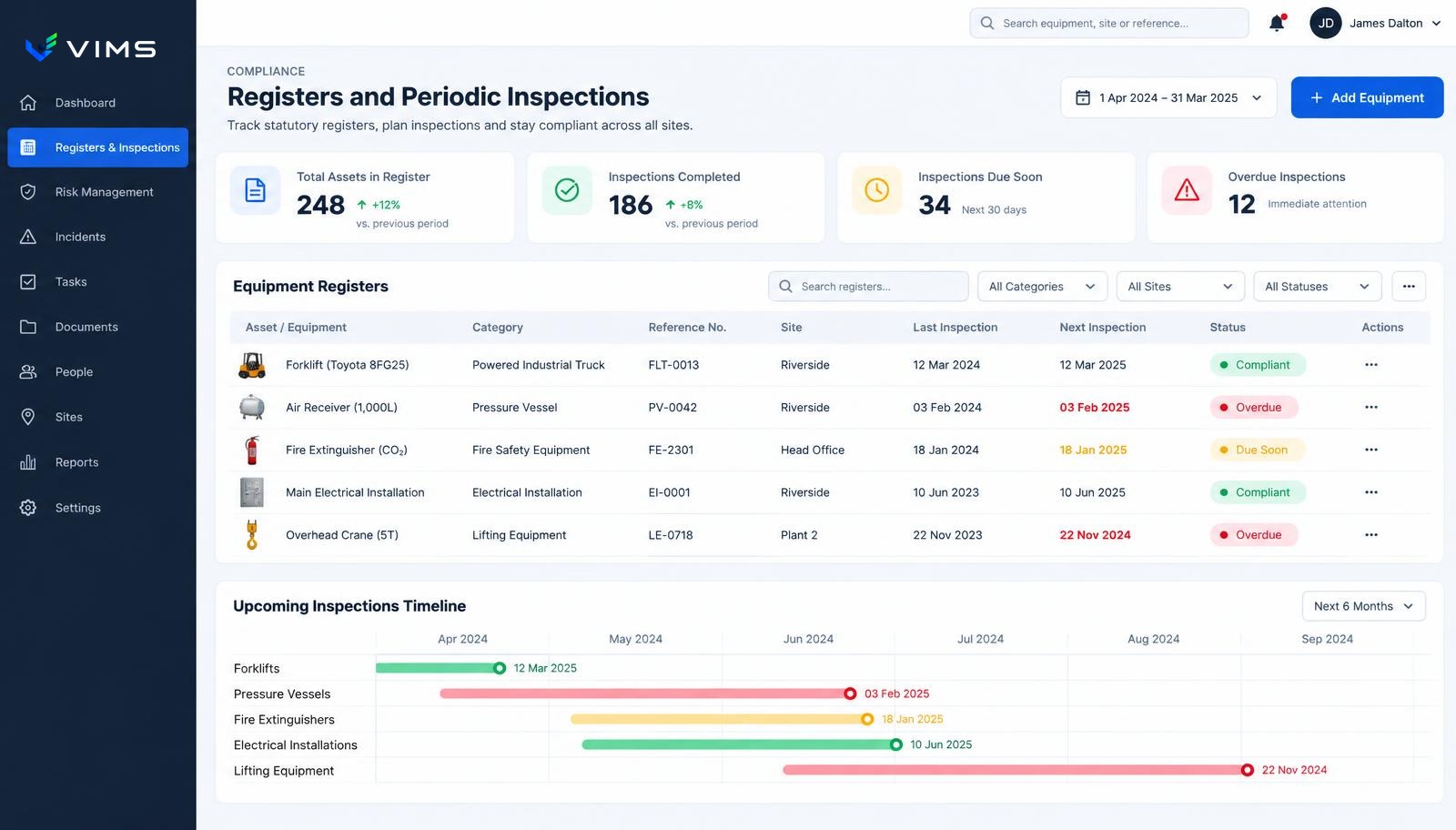
Registers and periodic inspections — deadlines tracked by the system, not by memory

A plant runs a dozen parallel registers: cranes, pressure vessels, forklifts, extinguishers, hydrants, electrical installations, ladders, hoists, gates. Each has its own cycle and its own owner. This module brings them into one register with one calendar.

  • Statutory inspections
  • Fire protection checks
  • Electrical testing
  • Building reviews
V-IMS — registers and periodic inspections module showing an equipment inventory with next inspection dates, validity statuses and a timeline of upcoming inspections

Why a spreadsheet of deadlines always fails eventually

An inspection register usually starts as a single file: equipment name, last inspection date, next inspection date. It works for the first few months. Trouble begins when the file starts living in several parallel versions — with maintenance, with the safety team, with the warehouse manager and in the mailbox of whoever last spoke to the service company.

The second source of error is the gap between a date and a document. The spreadsheet says the inspection happened, but the certificate sits in a binder, with the contractor or in an attachment from a year ago. During an inspection or a customer audit what counts is not the row in a table but the signed document, found in minutes.

The third problem is silence before the due date. A spreadsheet reminds nobody. News about an upcoming statutory inspection arrives only when someone deliberately opens the file and filters the dates — which in practice happens irregularly, and most often after the equipment has already been taken out of service.

VIMS reverses the order: the system watches the calendar and speaks first, and the register is one place where the asset, its cycle, its owner and every certificate live together.

One register for very different obligations

Recurring obligations come from completely different sources. Some follow statutory technical supervision and cover cranes, overhead travelling cranes, powered industrial trucks, pressure vessels or mobile platforms. Some cover fire protection: extinguishers, internal hydrants, smoke vents, emergency lighting, fire alarm systems. Another group is electrical installation testing and protection against electric shock.

Then come periodic building reviews, ladder and scaffold checks, ventilation and air-conditioning inspections, checks on personal protective equipment with a limited service life, calibration of measuring devices and internal machine reviews required by the manufacturer's documentation.

Instead of keeping a separate table for each group, VIMS defines an asset type and the cycle attached to it. One register remains, and filtering by category, location, owner or status replaces the separate files. The question "what is overdue across the plant?" then has an answer in a single view rather than after collecting four spreadsheets from four people.

What the Registers and inspections module gives you

Asset inventory

Machines, equipment, installations and gear with a number, location, category and responsible person.

Cycles and due dates

Inspection frequency attached to an asset type, with the next date calculated automatically.

Advance alerts

Notifications ahead of the deadline instead of finding out after it passed.

Certificates on the record

Scanned reports, statutory decisions and service documentation attached to the asset itself.

Complete history

The full chronology of inspections, repairs and shutdowns for one asset in one place.

Backlog view

What is overdue, what falls due within the month and what is scheduled further out.

How a periodic inspection flows through VIMS

The cycle repeats itself: once an inspection is closed the system calculates and watches the next date.

  1. 1Asset and inspection cycle entered
  2. 2Alert a set number of days before the date
  3. 3Inspection ordered and performed
  4. 4Certificate attached to the record
  5. 5Tasks raised from the remarks
  6. 6Next date generated automatically

When an inspection ends with a defect

The real value of a register appears when an inspection finds something wrong. A report with remarks and no next step is only an archive document. A remark can therefore become a task with an owner and a due date, and a more serious problem a full corrective action.

This matters for assets given a conditional release or a repair recommendation with a time limit. The system then shows two things at once: the next inspection date and the status of the outstanding repair. Without that link an organisation easily ends up with valid certificates and unfinished recommendations from the previous round.

Repetition becomes visible too. If the same hoist collects a brake remark at every inspection, it is no longer a service issue but a signal to replace it or change how it is used.

Distributed ownership, shared oversight

Inspections are not one person's job. Maintenance handles statutory equipment, fire protection usually sits with the safety team or facilities, electrical testing is ordered by the plant electrician, building reviews by the technical department. The register has to reflect that rather than force one person to type everything in.

In VIMS each asset has an owner who receives the notifications and is accountable for the inspection happening. The safety team and management see the consolidated picture without chasing each department separately.

At a management review or a certification audit that overview replaces a week of data gathering. Instead of a declaration that deadlines are under control, you show numbers: how many items are valid, how many are approaching their date and how many were missed, with the reason.

Frequently asked questions about registers and inspections

Can different equipment categories have different cycles?

Yes. The cycle belongs to the asset type and can be overridden on a single asset, for example when the manufacturer's documentation requires more frequent checks than the plant standard.

How far in advance is the notification sent?

The lead time is set with the cycle, separately for categories that need longer preparation, such as statutory inspections booked in advance, and for simple internal checks.

Are inspection certificates stored in the system?

The document is attached to the asset record, so the report, the decision and the repair history stay with the equipment instead of in a separate binder.

Can a remark from an inspection trigger an action?

Yes. A defect found during an inspection can become a task with an owner and a due date, and in serious cases a corrective action with effectiveness verification.

Who should own the register entries?

Ideally the department that actually orders the inspection. Owners can be split between maintenance, electrical, facilities and safety while everyone keeps the shared overview.

What about assets temporarily out of service?

The asset is marked with the appropriate status, so it does not create false overdue items, stays in the inventory and returns to its cycle once it is back in operation.

Related modules

Rounds and inspections

A safety walkaround is a cheap prevention tool, but only when it happens regularly and ends with an assigned task. This module enforces both conditions.

Rounds and inspections

VIMS module

Plan an audit or round, run it from a phone, record nonconformities and launch actions immediately — without retyping results into a spreadsheet.

Audits and inspections

VIMS module

No more action lists in a spreadsheet. Every action has an owner, a deadline, a status and an effectiveness check — all in one view.

CAPA

Bring every inspection deadline into one register

Book a demo and see the inspection calendar together with alerts and certificate history.