
VariloVIMS

VIMS for an integrated management system — one register instead of several parallel ones

Organisations running several management systems rarely lack knowledge. They lack synchronisation: the same actions appear in three plans, findings from different audits live in separate files, and management review starts with two weeks of data gathering. VIMS keeps one register of findings and actions for the whole system.

  • Audit plan
  • Findings
  • Actions
  • Requirement registers
  • Management review
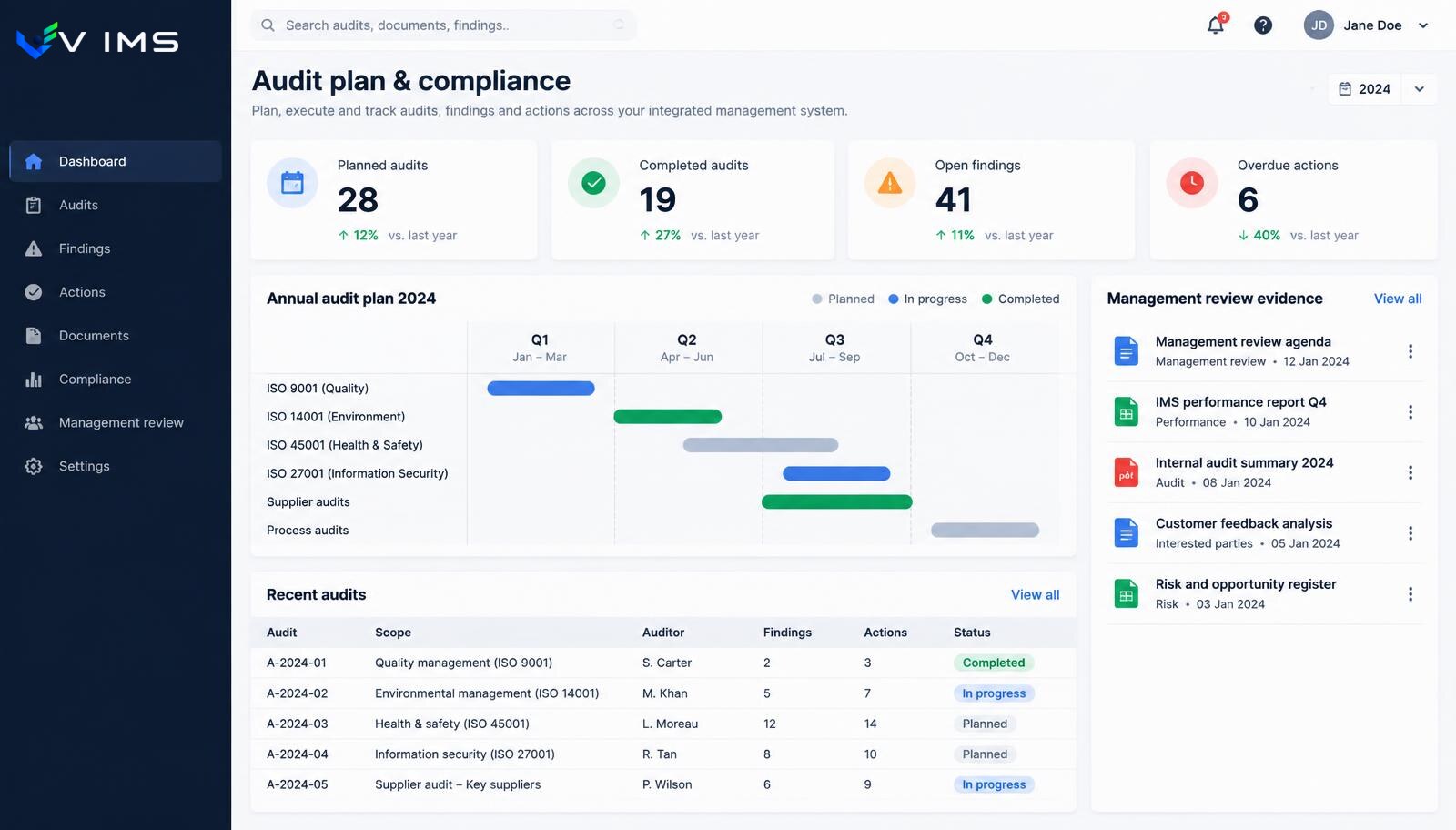
V-IMS — audit and compliance dashboard with an annual audit plan by quarter, planned and completed audits, open findings and management review evidence

The cost of running several systems side by side

An organisation with three or four implemented standards rarely duplicates processes on purpose. Duplication accumulates: each new area gets its own audit plan, report template and action register, because that was the fastest route at implementation time.

After a few years the effect is predictable. A production manager receives three different tasks that in practice concern the same work instruction. The system manager spends time reconciling which register is current instead of analysing findings.

The most expensive part is the missing common picture. When quality, environmental and safety findings sit in three files, nobody notices that all three point to the same weakness in controlling documentation changes.

One register of findings, many scopes

VIMS keeps an audit plan with scopes, dates and auditors, while findings go into a single register. Scope describes what a finding concerns; the action path is shared across the organisation.

For the system manager this means cross-cutting questions can be answered: how many findings are open past their date, which areas generate the most repeats, what share of actions passed effectiveness verification.

For line managers the change is simpler and more important: one task list instead of three, with a date and a clearly described expected evidence for each task.

The scope of an IMS and compliance function

Annual audit plan

Scopes, dates, auditors and delivery status in one view. A slipped date is visible immediately, not at year end.

Internal and supplier audits

Report, findings, classification and actions linked to a specific audit, with full status history.

Shared finding register across scopes

Findings from different areas in one register, tagged with scope. Recurrence shows across the system, not inside a single standard.

Actions with evidence and verification

Every finding leads to an action with an owner, a date, completion evidence and a planned effectiveness check.

Registers of requirements, reviews and dates

Recurring obligations kept as dated records instead of reminders in one person's calendar.

Management review data

Audit plan status, finding structure, action timeliness and backlog available continuously, without assembling before the meeting.

The flow in an integrated management system

The same path handles an internal audit finding, an inspection remark and an internal report.

  1. 1Annual audit plan with scopes
  2. 2Audit delivery and report
  3. 3Findings with classification
  4. 4Root cause where needed
  5. 5Actions with owner and evidence
  6. 6Effectiveness verification
  7. 7Cross-cutting reports
  8. 8Management review

Modules in this solution

Each module works on its own, yet together they form the single data flow described above.

VIMS module

Plan an audit or round, run it from a phone, record nonconformities and launch actions immediately — without retyping results into a spreadsheet.

Explore the module

VIMS module

No more action lists in a spreadsheet. Every action has an owner, a deadline, a status and an effectiveness check — all in one view.

Explore the module

Root cause analysis

Repeating events usually mean the previous investigation stopped at human error. This module walks the team through structured RCA techniques and makes sure every finding becomes a concrete action.

Explore the module

Registers and inspections

A plant runs a dozen parallel registers: cranes, pressure vessels, forklifts, extinguishers, hydrants, electrical installations, ladders, hoists, gates. Each has its own cycle and its own owner. This module brings them into one register with one calendar.

Explore the module

Management of Change (MOC)

Most serious events do not come from routine work but from something new: a replaced unit, an altered parameter, a different raw material, a reshuffled crew. MOC brings order to the moment when risk appears that no assessment describes yet.

Explore the module

Hazard reporting

The cheapest information in a plant is the one that arrives before an accident. This module shortens the path from spotting a hazard to deciding on an action, and makes sure the reporter hears back.

Explore the module

Contractor management

Collect the contractor's documents, verify their workers' qualifications, deliver the site induction and grant access before anyone passes the gate.

Explore the module

Integration is not merging documents, it is merging the flow

A typical integration attempt starts with the manual: three documents become one and the system is declared integrated. Operationally nothing changes, because tasks are still created in three places and land on three lists.

Real integration starts with the flow of findings and actions. If every finding — quality, environmental, occupational safety or information security — enters the same path, most coordination work disappears.

The second step is a shared dictionary: finding classification, cause categories and action types. Only then can results from different areas be compared, and management review stops being three presentations stapled together.

Why evidence matters more than status

'Closed' is a declaration. Evidence is a fact. In audit practice the difference surfaces within minutes, when someone asks to see the effect of an action taken a year ago.

It is worth requiring concrete evidence with each action: an updated instruction, a training record, a photo of the changed workstation, a measurement result. This is not formality — it prevents reconstruction from memory a year later.

The third element is effectiveness verification spread over time. An action can be performed correctly and still fail to remove the cause. Without a planned check you learn that only when the problem returns.

Questions from IMS and compliance teams

Does the system guarantee conformity with standards?

No. Conformity results from how the organisation operates and from the certification body's assessment. The system organises the audit plan, findings, actions and evidence — usually the parts that are missing during assessment.

Can several scopes share one register?

Yes. Scope is an attribute of a finding, not a reason to create a separate register, which is what makes cross-cutting reporting possible without manual merging.

How do we migrate open actions from spreadsheets?

Migrate genuinely open cases and formally close what was long ago completed. Importing an unreviewed backlog undermines the new register from day one.

Can an external auditor see the data?

Access scope is the organisation's decision. In practice, exporting selected reports and evidence is used more often than granting outside access.

Can management review be prepared from the system?

Plan, finding and action data are available continuously. Interpretation and conclusions remain the team's work — the system supplies material, not decisions.

Can contractors be covered by the same oversight?

Yes. External company requirements and documents are kept as dated records, and findings about their work enter the shared action register.

Other solutions

Solution for safety teams

See

Solution for quality

See

Solution for food safety

See

Solution for fire safety

See

Let us tidy up your integrated system

We will show how an audit plan, findings and actions from several areas can work in one register.