
VariloVIMS

VIMS for quality — from a nonconformity to effective CAPA

Most quality systems do not fail at registering nonconformities. They fail at proving the action worked. VIMS runs the whole path: recording the deviation, establishing the cause, an action with an owner, and the moment someone checks whether the problem came back.

  • Nonconformities
  • Root cause
  • CAPA
  • Audits
  • Change
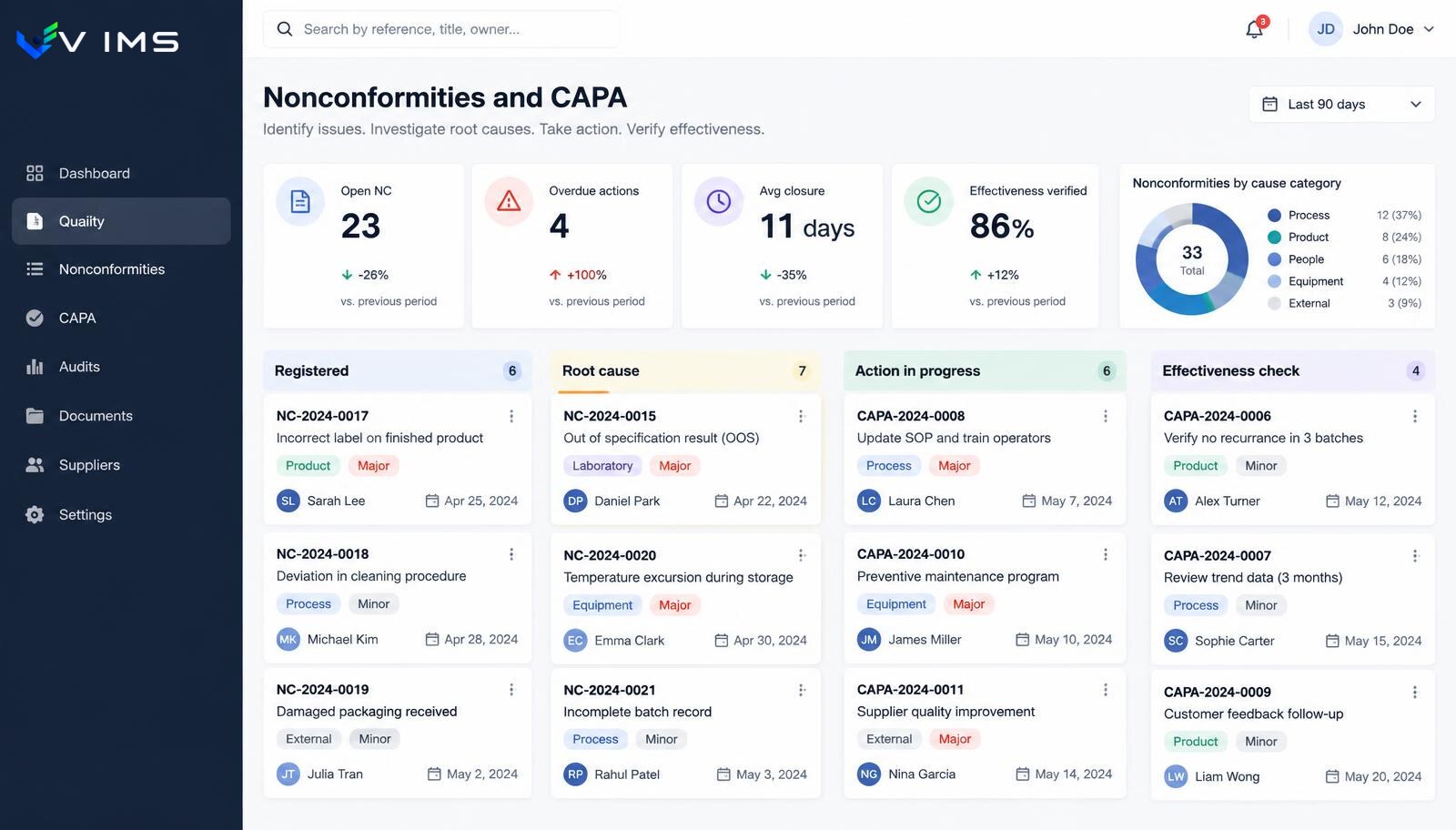
V-IMS — nonconformity and CAPA board with registered, root cause, action in progress and effectiveness check columns, open NC metrics and a cause category chart

Three places where a CAPA process loses credibility

The first is registration without selection. When every small remark becomes a formal nonconformity with a full path, the team cannot keep up and serious cases disappear in the crowd. A classification that decides the depth of the investigation is essential.

The second is analysis in name only. The cause field reads 'human error' or 'operator inattention', which ends the thinking exactly where it should start. Such a record leads to no meaningful action beyond a refresher briefing.

The third is closing without verification. The action is done, the status flips to closed, and nobody checks whether the deviation stopped. Months later the same nonconformity reappears, this time at the customer.

The same process with connected data

In VIMS a nonconformity is a record with classification, owner and context: area, line, product, supplier. Classification drives the path — some cases end with a correction, others trigger a full investigation with root cause analysis.

Analysis uses a shared cause dictionary, so the data can be aggregated. Only then does it become visible that twenty percent of deviations share one process source rather than twenty separate immediate reasons.

Actions carry an owner and a verification date separate from the completion date. Closure follows the check, not the claim of completion. That single change does more for register credibility than any other.

The quality department's scope in one system

Nonconformity and deviation register

Records with context: area, line, product, batch, supplier. Classification decides whether the case ends with a correction or a full investigation.

Root cause analysis with a shared dictionary

Findings stored in standard categories, so recurring sources appear in a report instead of living in the team's memory.

Corrective and preventive actions

Separate completion and verification dates, a clear owner and visible delay status without chasing people for updates.

Effectiveness verification

A planned moment to check whether the deviation stopped. A failed check reopens the case instead of erasing it.

Internal and process audits

Plan, scope, findings and actions in one place. An audit finding enters the same flow as a production nonconformity.

Reports for management review

Numbers you can defend: closure time, share of verified actions, cause recurrence and the backlog position.

The nonconformity flow in VIMS

The path is the same whether the case comes from production, an audit or a customer complaint.

  1. 1Deviation recorded with context
  2. 2Classification and path selection
  3. 3Root cause analysis
  4. 4Corrective and preventive action
  5. 5Completion and evidence
  6. 6Effectiveness verification
  7. 7Closure or reopening
  8. 8Report for management review

Modules in this solution

Each module works on its own, yet together they form the single data flow described above.

Hazard reporting

The cheapest information in a plant is the one that arrives before an accident. This module shortens the path from spotting a hazard to deciding on an action, and makes sure the reporter hears back.

Explore the module

Root cause analysis

Repeating events usually mean the previous investigation stopped at human error. This module walks the team through structured RCA techniques and makes sure every finding becomes a concrete action.

Explore the module

VIMS module

No more action lists in a spreadsheet. Every action has an owner, a deadline, a status and an effectiveness check — all in one view.

Explore the module

VIMS module

Plan an audit or round, run it from a phone, record nonconformities and launch actions immediately — without retyping results into a spreadsheet.

Explore the module

Registers and inspections

A plant runs a dozen parallel registers: cranes, pressure vessels, forklifts, extinguishers, hydrants, electrical installations, ladders, hoists, gates. Each has its own cycle and its own owner. This module brings them into one register with one calendar.

Explore the module

Management of Change (MOC)

Most serious events do not come from routine work but from something new: a replaced unit, an altered parameter, a different raw material, a reshuffled crew. MOC brings order to the moment when risk appears that no assessment describes yet.

Explore the module

Classification that does not drown the process in formality

A working register distinguishes at least three levels. Immediate correction: the deviation is removed on the spot and logged for statistics, with no further path. Standard investigation: a simplified cause statement and one or two actions. Full investigation: team analysis, actions across several areas, mandatory verification.

The criterion should be operational rather than discretionary: customer impact, recurrence, risk to safety or product conformity. If it fits in one sentence that cannot be read two ways, classification stops generating arguments.

The side effect matters: the quality team stops resisting the registration of small issues, knowing a small issue will not trigger a three-week procedure. The data becomes more complete.

Linking quality to process change

A large share of deviations follows a change: a different raw material supplier, a new machine setting, a modified instruction, a new crew. If the change register lives apart from the nonconformity register, that link stays invisible.

In VIMS a change can be linked to a nonconformity, and a change request can result from a corrective action. Analysis then shows not only what happened but what preceded it in the process.

The same applies to audits. An audit finding that ends in a process modification should lead to a formal change, not to an informal adjustment passed on verbally during a shift.

Questions from quality departments

Does the system impose a specific root cause method?

No. It supports the investigation and stores findings in standard categories. How the team works through the analysis remains the organisation's choice.

Can customer complaints run in the same flow?

Yes, if configured that way. A complaint becomes a nonconformity with a defined source that enters the same action and verification path.

How do we avoid a register full of years-old open cases?

Before going live, formally close what was actually done and migrate only genuinely open cases. A register that starts with an old backlog loses credibility immediately.

Does the system calculate effectiveness automatically?

It shows how many actions passed their planned verification and how many were reopened. Judging whether the action was the right one stays with the team.

Is this for series or one-off production?

The flow is identical. What differs is the context stored with the nonconformity: batch and line, or order and project.

How is data prepared for management review?

Data accumulates as work happens, so the review is about interpreting reports rather than building them in a spreadsheet the week before.

Other solutions

Solution for safety teams

See

Solution for food safety

See

Solution for audit and compliance

See

Solution for fire safety

See

Let us walk through your nonconformity flow

We will show the path from recording a deviation to confirming the action actually solved the problem.