
VariloVIMS

Data security and access control in the VIMS platform

Safety teams choose a system for its features. IT departments approve it after getting answers about hosting, tenant isolation, authentication, change history and exit terms. This page collects those answers in one place and describes only the mechanisms genuinely running in the production build of VIMS — no aspirational claims and no borrowing certificates from our infrastructure provider.

  • EU data region
  • Mandatory 2FA
  • Tenant isolation
  • Security event log
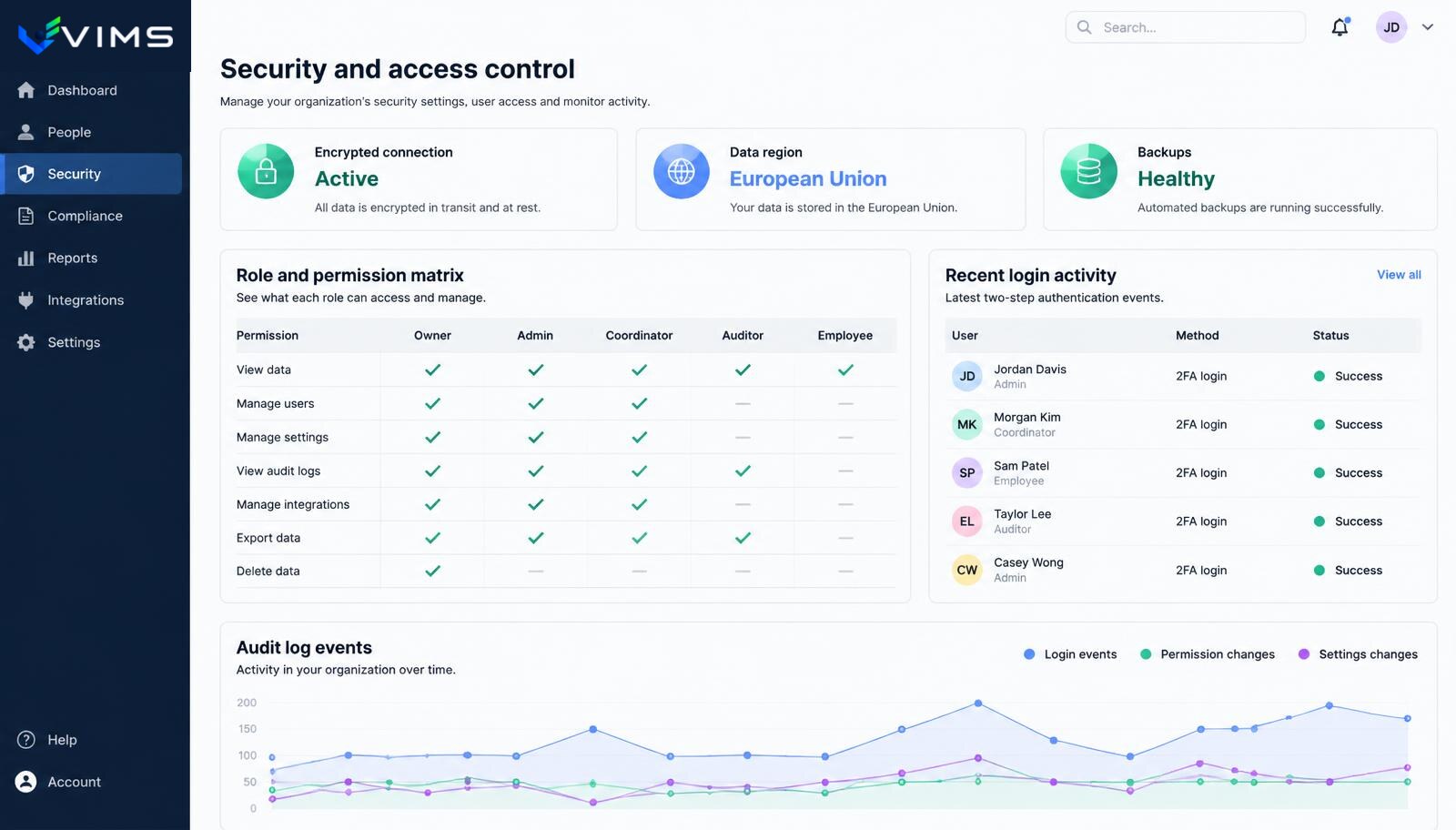
v-ims security and access control panel in the VIMS platform — role and permission matrix, two-step login activity, backup status and audit log event chart

Why EHS data deserves its own security conversation

Records kept by a safety function are among the most sensitive datasets in any organisation. An accident register describes a named person's injuries. Medical examination records speak to fitness for work. A concern report may identify a supervisor. A post-incident interview note can resurface years later in an employment dispute. Each of these follows a different access logic, and together they form a dataset whose exposure is simultaneously a legal problem, a reputational problem and a human one.

That is why buying EHS software rarely ends with the safety manager's decision. An IT administrator joins to ask about architecture, a data protection officer asks about lawful basis and processing agreements, and in larger groups an information security lead asks what happens when an employee loses a phone or when the supplier relationship ends.

We wrote this page so it can be forwarded as a working document. Instead of slogans it describes concrete mechanisms: where the data physically sits, how one organisation is separated from another, how authentication actually works, which events are recorded, and in what form a customer can take their data away.

The rule we follow when describing security

We committed to a rule that is commercially inconvenient: we publish only what is implemented and can be demonstrated live during a technical review. If a mechanism is planned, we call it planned. If a certificate belongs to our infrastructure provider rather than to us, we do not present it as our own achievement — a common and misleading shortcut in this market.

In practice this page contains no claims of full legal compliance, no talk of absolute security and no features you could not click through today. What it does contain is a description of specific technical measures, their parameters, and where relevant an honest note about limitations and work in progress.

If your IT function runs a formal supplier assessment against its own security questionnaire, we complete it in writing before the contract is signed. The technical session can be held separately from the functional demo, with the person responsible for system architecture present.

Six pillars of security in the VIMS platform

Infrastructure and data region

The application and database run on managed cloud infrastructure inside the European Union. Data stays within the European legal space, with no routine transfer outside the EEA.

Encrypted transport

All traffic between the browser, mobile device and server runs over HTTPS with current TLS versions. The application exposes no unencrypted endpoints.

Tenant isolation

Every organisation is a separate data space. Separation is enforced inside the database at row level, not merely by a filter in the interface. A query from outside the organisation returns nothing.

Mandatory two-step login

The second authentication factor is enabled by default on every account. After the password, users confirm with a one-time code, and a device can be remembered as trusted for a limited period.

Security event log

A dedicated server-side log records access events: login code delivery and verification, changes to authentication settings, membership and role changes, data exports and sensitive-data reveals.

Data export and ownership

An owner or administrator can download an archive of their organisation's data as a file bundle. The action is recorded in the event log together with who performed it.

The path of a record from the shop floor to the register

Every entry travels the same controlled route, whether it is created on a phone next to a machine or on a specialist's desktop.

  1. 1The user signs in with a password and confirms identity with a one-time code
  2. 2The session receives an organisation context derived from approved membership
  3. 3The connection to the server is encrypted end to end
  4. 4The database checks permissions on the specific record, not just on the screen
  5. 5The entry is written into a single organisation's data space, isolated from others
  6. 6Attachments land in storage with no public address, served through a server layer
  7. 7Access and administrative events are written to the security log
  8. 8An authorised person can download the organisation archive, and that fact is recorded

Authentication: exactly how signing in to VIMS works

Signing in takes two steps. The first is the familiar email and password pair; passwords are never stored in clear text and verification is handled by an authentication layer built on proven, standard cryptographic mechanisms. The second step is a one-time code that the system sends to the email address registered to the account.

The code is six digits long and generated with a cryptographically secure random number generator. The code itself is never written to the database — only its cryptographic digest is stored, so even someone with read access to that record cannot reconstruct the value needed to sign in. It remains valid for ten minutes and then expires. Entry attempts are capped at five, and a new code can be requested no more than once every sixty seconds, which limits both guessing and mailbox flooding.

The code is sent automatically the moment the second step opens — users do not have to request it with an extra click. If the message does not arrive, a resend button with a visible countdown is available. After a successful confirmation the device can be marked as trusted, in which case sign-ins from that device skip the code for thirty days. A trusted device can be revoked, which immediately restores the full two-step procedure.

Two-factor authentication is active by default on every new account. Changing that setting is a deliberate user action and is written to the security event log, so an organisation administrator can see who weakened their own sign-in protection and when.

The access model: organisation, membership, role

A VIMS user account on its own grants access to no operational data at all. Access follows from membership in an organisation. A request to join lands in a pending state and must be reviewed by that organisation's owner or administrator. Until approval the user sees not a single record — there is no scenario where simply registering with a company email address unlocks the registers.

Within an organisation, roles carry different scope: owner, administrator and member. The owner governs the whole space, including data export and archiving. The administrator handles day-to-day user management and configuration. A member works with operational data within the scope their role allows. A separate platform-level permission layer exists purely for technical and administrative support of the service itself.

Permissions live in their own table and are evaluated by a dedicated database function running with elevated rights, outside the ordinary read path. This is a deliberate architectural choice: it removes the most common design flaw in multi-tenant applications, where a user can edit their own profile record and promote themselves in the process.

Every membership and approval-status change is written to the security event log. During an internal audit or a dispute about who authorised what, it is possible to reconstruct who granted access to organisation data and when.

Isolation between companies — the mechanism that matters most

VIMS is a multi-tenant platform: independent organisations work side by side in the same instance, and in the external safety-consultancy model a single adviser may run more than a dozen client companies. Security in that arrangement cannot rest on the interface showing a suitably filtered list. An interface filter protects against mistakes, not against deliberate circumvention.

Separation is therefore enforced directly in the database, at the level of the individual row. Every significant dataset has that protection switched on, and access rules describe who may read, insert, modify and delete each record. A query issued by a user outside the organisation is not answered with a permission error — it simply returns nothing, because in that context the record does not exist.

Files are protected the same way. Photographs documenting incidents land in a space with no public path: they cannot be reached by direct address, and access runs exclusively through a controlled server layer that checks permissions. That matters, because a photograph from an accident scene is often more sensitive than the report describing it.

Revealing specially protected data in the administrative interface is recorded as its own event. We do not block people who legitimately need to see such data — we document the fact that they saw it.

Event log, document history and continuity

The security event log is written server-side, independently of anything the user does in the browser. Each entry holds an organisation identifier, a user identifier, an event name, a timestamp and a set of contextual data. Recorded events include login code delivery and successful verification, failed code delivery, enabling and disabling two-factor authentication, organisation creation, membership changes, data exports and sensitive-data reveals.

Beyond that log, the process modules keep their own history. An incident retains the trace of each investigation stage, a root cause analysis stores successive versions of its findings, and module configuration changes are recorded together with their author. During an external audit the conversation therefore moves past whether something was done, to when and by whom.

The data layer runs on a managed database service with automated backups taken by the infrastructure provider. Environment recovery is performed from those backups. We do not publish a contractual restoration time as a commercial standard — specific continuity parameters, including availability levels, are agreed individually in the contract where an organisation requires them.

Acceptances of legal documents — terms of service and the data processing policy — are stored together with the document version and date. When wording changes, it stays visible who accepted which version, which is often the first question during an inspection.

GDPR, processing agreements and leaving the service

In the customer relationship VIMS acts as a processor on behalf of the controller, which remains the organisation using the system. Cooperation requires a data processing agreement; we prepare it alongside the main contract and attach it to tender documentation whenever the buyer expects it.

The scope of personal data processed depends on which processes the organisation chooses to run. Launching an incident register requires a narrower scope than maintaining medical examination records or a training register. We recommend consciously limiting collected fields at implementation time to those genuinely needed — both good practice under the minimisation principle and simpler to maintain.

Customers retain ownership of their data throughout the relationship and after it ends. The organisation archive can be downloaded directly from the system, with no request form and no waiting on support. The action is available to the owner and administrator, and its execution is recorded.

Deletion of data after the relationship ends is performed on the controller's written instruction, within the mode and timeframe agreed in the processing agreement. We do not hold data hostage as leverage during subscription renewals.

What is not there yet — stated plainly

Single sign-on against a corporate identity provider, and a public documented API for integration with HR and maintenance systems, sit on the product roadmap and are not available today as features you can switch on. We keep them off the capability list because for an IT department this is decisive information, not a nice-to-have.

We hold no information security management certification of our own. The infrastructure the platform runs on is maintained by an external cloud provider with its own certifications, but we do not treat that as our certification and do not present it that way.

Nor do we publish a guaranteed availability level as a marketing figure. If your organisation requires a contractual commitment on that point, it is a matter for individual negotiation rather than a claim on a website.

This approach occasionally lengthens the sales conversation and consistently shortens the implementation. An IT department handed an honest list with clearly marked gaps decides faster than one that has to verify promises.

Questions IT departments ask most often

Does our company data leave the European Union?

The database and application run in a European Union region. In routine operation data is not moved outside the European Economic Area. If your organisation needs written confirmation of the location, we attach it to the implementation documentation and to the data processing agreement.

Can we disable two-step login for all employees?

The second factor is on by default on every account and we recommend leaving it that way, particularly where registers hold health-related data. The setting can be changed at account level, but every activation and deactivation is written to the security event log and therefore stays fully visible to the organisation administrator.

What happens if an employee loses a phone they were signed in on?

A device remembered as trusted can be revoked, which immediately forces the full sign-in procedure with a one-time code. Independently of that, trust expires by itself after thirty days and the device session is itself time-limited.

Can an employee of one company see another company's data?

No. Separation operates in the database layer at row level, not merely by filtering a list in the interface. A query executed in another organisation's context returns no record. The same applies to a safety consultant serving multiple clients — they see only the organisations where their membership has been approved.

Who can read the security event log?

Authorised people on the organisation side, according to their role. Entries are produced server-side and are neither created nor modified through the user interface, so they cannot be tidied up from a browser.

Does VIMS support single sign-on with our corporate domain?

Not in the current version. Single sign-on and a public API for HR system integration are on the roadmap but are not available today. We say so plainly, because for some organisations it is a hard requirement when selecting a supplier.

Do you hold an ISO 27001 certificate?

We hold no information security management certification of our own, and we do not present our infrastructure provider's certificates as ours. We describe only mechanisms that genuinely run in the system and that can be verified during a technical review.

How do we get our data back if we end the relationship?

An owner or administrator can download the organisation archive directly from the system, with no request form. Deletion of data after the relationship ends is performed on the controller's written instruction, in the mode agreed in the data processing agreement.

Modules handling sensitive data

Employees and competence

The same people appear on the training list, in the examination schedule, in a risk assessment, on a work permit and in an accident report. If each of those lists lives its own life, sooner or later they stop agreeing. This module fixes the problem at the data level, not at the form level.

Explore the module

VIMS module

Report an event in seconds, run the root cause analysis, plan actions and close the case with complete documentation in one place.

Explore the module

VIMS module

One substance register, current safety data sheets available from a phone and full control over what is used where on site.

Explore the module

VIMS module

Plan an audit or round, run it from a phone, record nonconformities and launch actions immediately — without retyping results into a spreadsheet.

Explore the module

We will prepare the answers for your IT department

Send us your security questionnaire or book a technical review. We will show role configuration, the event log and the data export live rather than on a slide.