
VariloVIMS

VIMS for food plants — hygiene, quality and safety in one register

A food plant is audited more often than almost any other site: by retail customers, certification bodies and inspectors. Each audit essentially asks the same thing — were last time's findings closed, and what proves it. VIMS assembles that evidence as work happens instead of letting it appear in the week before a visit.

  • Hygiene walks
  • Audits and findings
  • Cleaning chemicals
  • Zones and access
  • Actions and evidence
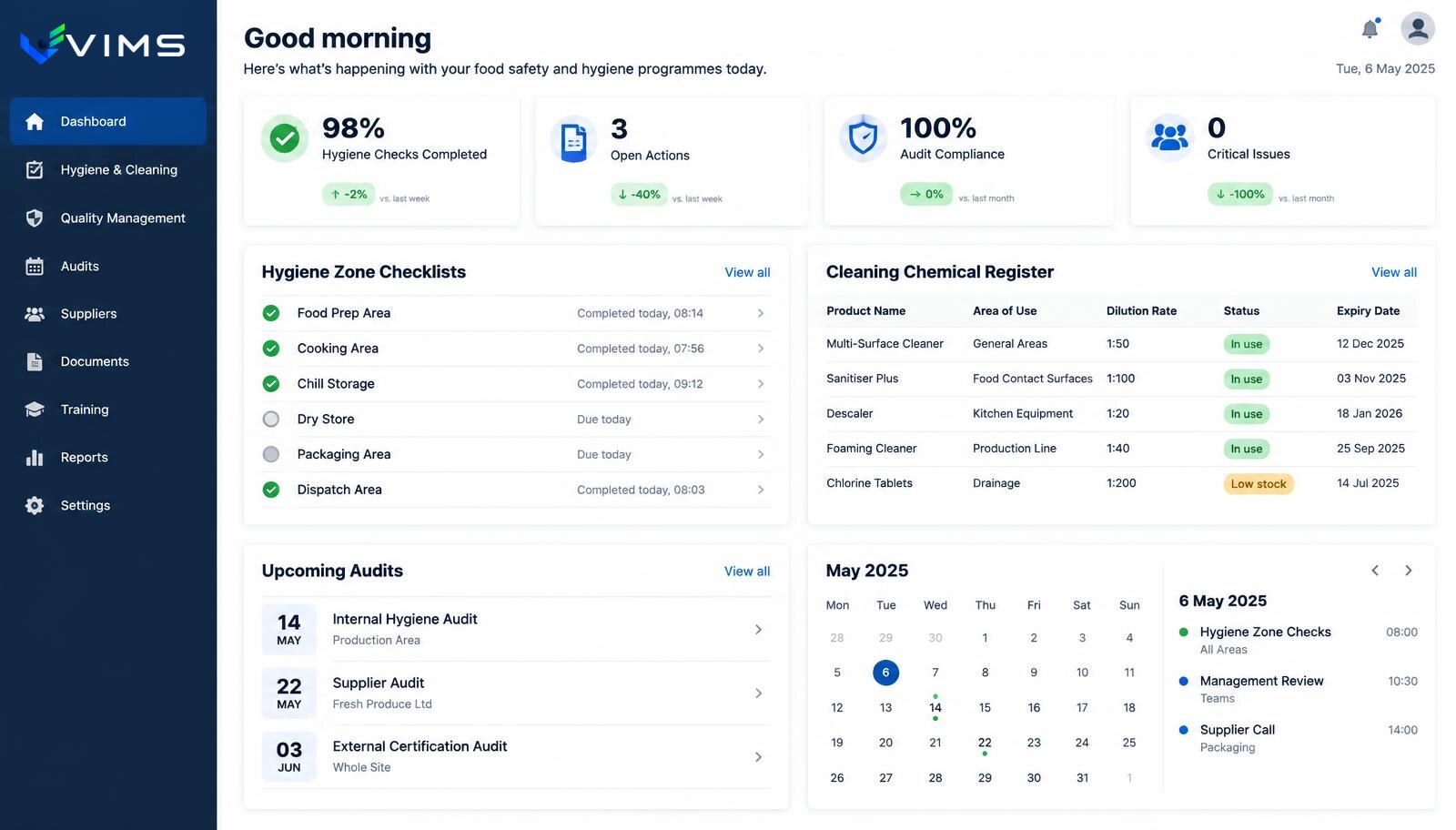
V-IMS — food plant dashboard: hygiene checklist completion by zone, cleaning chemical register with expiry dates, upcoming audits and a task calendar

An audit cycle that never ends

In practice a food plant's year is divided into audit windows rather than quarters. Certification audits, customer audits, internal audits, sanitary inspections — each leaves a list of findings, and each list usually goes into a separate file kept by whoever hosted that visit.

Every quality department knows the result: before the next audit, evidence must be gathered from several sources and reconstructed. That work adds nothing to product safety and consumes the most experienced people on site.

The second issue is the split between hygiene and occupational safety. A hygiene walk finds a damaged guard, a safety walk finds an unlatched gate — recorded in different systems even though both lead to the same kind of action and often to the same owner.

One finding list, whatever the source

Mechanically, VIMS does not distinguish a customer audit finding from a hygiene walk remark: both become an item with an owner, a due date, a zone and required evidence. Only the source and classification differ, and those are filters.

So when an auditor asks how last year's nonconformity was closed, the answer is a single view: the report, the analysis, the action, who performed it, when, and what evidence was attached.

The third element is zoning. Observations, chemicals and contractor access all refer to a specific hygiene zone, so 'what happened in the high-risk zone last quarter' needs no manual query.

Features that matter in a food plant

Hygiene walks on a phone

Zone checklists completed at the point of inspection, with a photo of the deviation and a corrective task created on the spot.

Internal and customer audits

Audit plan, scope, findings and their classification in one register, including audits run by your customers.

Cleaning chemical register

Cleaning and disinfection agents with safety data sheets, working concentrations, areas of use and required protection.

Contractors inside zones

Verification of documents and briefings for service crews before they enter production, plus a record of the work they did.

Training and health checks

Status of job, hygiene and medical requirements visible in one view for a whole shift.

Actions with proven effectiveness

Every finding ends in an action, and every action in evidence: a photo, a document or a follow-up check.

From observation to proof of closure

The same path handles a walk remark, an audit nonconformity and an employee report.

  1. 1Observation in a zone
  2. 2Finding classification
  3. 3Product containment
  4. 4Root cause
  5. 5Corrective action
  6. 6Execution and evidence
  7. 7Follow-up check
  8. 8Documented closure

Modules used in this industry

The starting set follows the processes that generate the most work and the most risk in this environment.

Rounds and inspections

A safety walkaround is a cheap prevention tool, but only when it happens regularly and ends with an assigned task. This module enforces both conditions.

Explore the module

VIMS module

Plan an audit or round, run it from a phone, record nonconformities and launch actions immediately — without retyping results into a spreadsheet.

Explore the module

VIMS module

One substance register, current safety data sheets available from a phone and full control over what is used where on site.

Explore the module

VIMS module

See in one view who holds valid training and qualifications, whose certificates expire soon and what is missing for a given job.

Explore the module

Contractor management

Collect the contractor's documents, verify their workers' qualifications, deliver the site induction and grant access before anyone passes the gate.

Explore the module

Hazard reporting

The cheapest information in a plant is the one that arrives before an accident. This module shortens the path from spotting a hazard to deciding on an action, and makes sure the reporter hears back.

Explore the module

VIMS module

No more action lists in a spreadsheet. Every action has an owner, a deadline, a status and an effectiveness check — all in one view.

Explore the module

Medical examinations

An expired medical certificate means a worker cannot be allowed to work. With a hundred people a spreadsheet still copes. With several hundred, turnover and shift work you need a register that raises upcoming dates by itself.

Explore the module

Evidence you do not have to assemble before a visit

The expensive part of an audit is not the audit but the preparation. If evidence is produced during normal work — a photo of the repair, a sign-off on cleaning, a dated inspection record — then the week before a visit is unremarkable.

VIMS stores those traces as they appear and links them to the finding they belong to. An auditor does not browse a folder of scans; they follow a path: observation, action, confirmation.

A side effect is visible repetition. When the same remark returns to the same zone for the fourth time, that is an argument for a technical or procedural change rather than another briefing.

Hygiene and safety stop competing for attention

In many plants, quality and safety run parallel checks over the same areas, on different dates and with different forms. To an operator this looks like two obstacles rather than one supervision system.

Combining both streams in one register does not erase the difference in content — the checklists and owners stay separate. It changes the aggregate picture: an area manager sees every open point for their zone in one place.

It also helps planning. If a quality check and a safety walk fall in the same week, the clash can be resolved deliberately instead of discovered on the day.

Questions from food producers

Does VIMS replace a HACCP system?

No. VIMS organises operational supervision — walks, audits, nonconformities, actions and personnel records. The HACCP plan and product documentation stay in the plant's quality system.

Can checklists be tailored to zones?

Yes. Question sets are assigned to a zone or inspection type, so a high-risk zone walk differs from a packaging store check.

How is external crew supervision handled?

Each contractor has a record with documents and expiry dates. A missing valid document is visible before the crew is allowed on site.

Can customer audits be recorded separately?

Yes. An audit carries a type and source, so customer, certification and internal findings remain distinguishable while sharing one action register.

Can a production operator use the app?

The employee interface is limited to a few actions: reports, checklists and personal documents. Training at that scope usually takes a quarter of an hour.

Other industries

Industry: manufacturing and heavy industry

See

Industry: logistics, warehousing and distribution

See

Industry: construction and contracting

See

Industry: multi-site organisations

See

Industry: EHS consultancies and outsourced safety services

See

Let us walk through your audit cycle

We will show the path from an auditor's finding to documented closure inside your zones.