
Medical examinations — certificate validity tracked without paging through files

An expired medical certificate means a worker cannot be allowed to work. With a hundred people a spreadsheet still copes. With several hundred, turnover and shift work you need a register that raises upcoming dates by itself.

  • Occupational health
  • Preventive examinations
  • Workplace exposures
  • Fitness for work
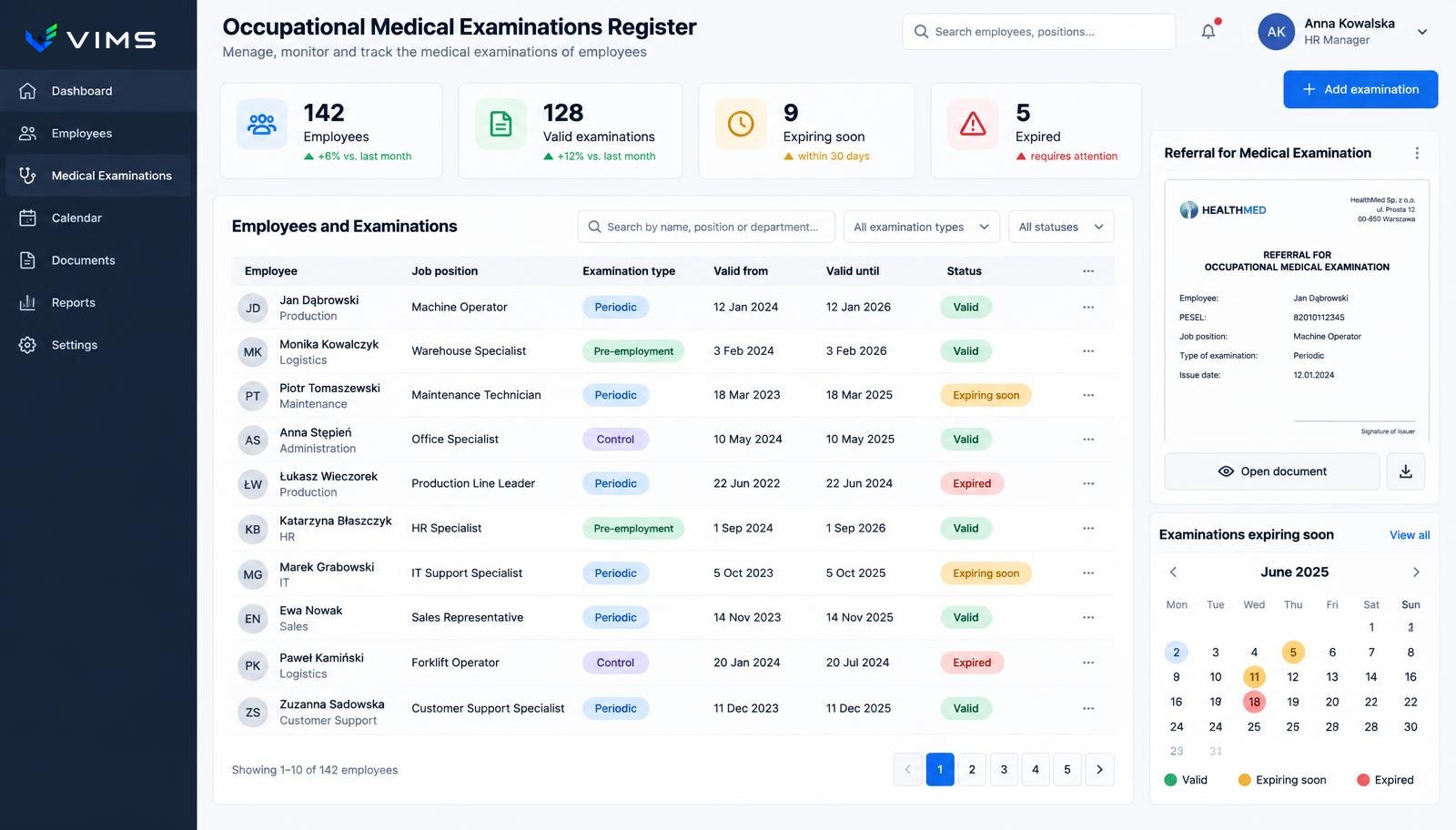
V-IMS — employee medical examinations module showing people with job positions, examination types, certificate validity dates, statuses and a referral document preview

Three kinds of examination, three different moments

A pre-employment examination applies to someone being hired or moved to a workplace with different conditions. Its defining feature is time pressure: without a valid certificate a new worker cannot start, and recruitment rarely leaves spare days.

A periodic examination is routine, and that is exactly where most deadlines are lost. A certificate valid for two, three or four years expires at a moment nobody remembers, and workers rarely track their own dates. The deadline therefore has to announce itself, early enough to book an appointment at the occupational health provider.

A follow-up examination after a longer absence has a completely different rhythm — it comes from an event, not a calendar. In a spreadsheet built around an annual cycle such cases usually are not captured at all, so the decision to let someone work rests on a supervisor's memory.

The VIMS register handles all three in one inventory while keeping their type distinct, so you see not only whether a certificate is valid but why it was issued.

A referral starts from the workplace, not the person

The scope of a preventive examination follows the harmful, arduous and dangerous factors present at the workplace: noise, dust, chemicals, work at height, manual handling, screen work or driving a forklift. The workplace, not the individual, defines what the referral must contain.

That is why most errors appear when a referral is copied from the previous employee without checking whether conditions changed. A new substance in the process, an added truck or a change in work organisation all mean the scope should be updated.

In VIMS the workplace profile is shared with the risk assessment and training requirements. A change on the exposure list is therefore visible in one place instead of three independent documents kept by three different people.

The practical effect is simple: when referring someone for an examination you do not reconstruct their workplace from scratch — that information already exists in the system.

What the Medical examinations module gives you

Certificate register

Pre-employment, periodic and follow-up examinations with issue date, validity and type.

Expiry alerts

Notice early enough to book the appointment, not on the day the certificate lapses.

Scope from the workplace

Harmful and arduous factors pulled from the workplace profile when preparing the referral.

Fitness overview

A fast answer to who holds a valid certificate and who must not be allowed to work.

Documents with the employee

Referrals and certificates attached to the personal profile, with previous examinations kept.

Reports for HR and safety

Status by department, position and shift, with a list of overdue items.

How a preventive examination flows

The cycle closes itself: once a new certificate is entered the system calculates and watches the next date.

  1. 1Scope taken from the workplace profile
  2. 2Referral issued to the employee
  3. 3Appointment at the occupational health provider
  4. 4Certificate and validity date recorded
  5. 5Fitness status shared with the supervisor
  6. 6Alert before the next periodic examination

Sensitive data: a register of dates, not medical records

The module keeps administrative facts: examination type, issue date, validity, and whether the person is fit for the role or has restrictions. It is not a place for medical records, test results or diagnoses — those stay with the occupational health provider.

The distinction matters when designing permissions. A supervisor needs one piece of information: whether the worker may do their job today. HR needs dates and referral documents. Neither role requires access to medical content.

It is worth agreeing visibility during rollout and keeping to least-privilege access. The register exists to reduce the risk of letting someone work without a valid certificate, not to create a new health database.

Where examination dates meet the rest of the processes

Certificate validity is not purely an HR matter. When issuing a permit for high-risk work, for work at height or for operating statutory equipment, confirmed fitness is one of the conditions for release — alongside qualifications and training.

Examination data therefore only makes sense together with the other workplace requirements. Someone with a valid certificate but overdue refresher training is just as ineligible as the reverse: trained, but without an examination.

The third link is the risk assessment. If an incident or a process change introduces a new factor at a workplace, the scope of the next examination may need to change. In scattered spreadsheets that conclusion rarely reaches the person writing the referral.

Frequently asked questions about medical examinations

Does the system store medical test results?

No. The register covers administrative data: examination type, certificate date, validity and fitness or restrictions. Medical records remain with the occupational health provider.

Where does the referral scope come from?

From the workplace profile, which describes harmful, arduous and dangerous factors. The referral then matches real conditions instead of a copy from years ago.

How early does the system flag an expiring certificate?

The lead time is configured by the organisation. In practice it should be long enough to book the appointment and any additional tests.

Does the module handle follow-up examinations after illness?

Yes. A follow-up examination is recorded as its own type because it arises from an event rather than a cycle and must be confirmed before the person returns to work.

Who should have access to the register?

Usually HR and the safety team for the full register, while supervisors see only the fitness status of the people reporting to them.

Is examination data connected to other workplace requirements?

Yes. Certificate validity is reviewed together with training and qualifications, because permission to work depends on all of those conditions being met.

Related modules

VIMS module

See in one view who holds valid training and qualifications, whose certificates expire soon and what is missing for a given job.

Training and qualifications

VIMS module

Run risk assessment online: hazards, risk levels, control measures and reviews in one place, connected to what actually happens on site.

Risk assessment

Permit to work

No more paper permits travelling around the site in search of a signature. The application, task risk assessment, approvals and working conditions run in one workflow visible to everyone involved.

Permit to work

Bring preventive examination dates under control

Book a demo and see the certificate register together with alerts for upcoming expiry dates.