
VIMS EHSVIMS EHS

Fire extinguisher and hydrant inspections — intervals, check scope and documentation

Extinguishers and indoor hydrants are a site's basic firefighting equipment and must be serviceable at any moment — not 'almost always'. Fire regulations require periodic inspections and servicing by authorised providers, while the building owner is responsible for punctuality and records. A missing extinguisher service is among the most common findings of fire service inspections.

This guide shows how often extinguishers and hydrants are serviced, what to read on the nameplate, what an interim checklist should cover and how to keep a register that survives dozens of fire points.

  • Extinguisher inspections
  • Indoor hydrants
  • Fire equipment servicing
  • PPE fire safety
  • Inspection register

Published: 2026-10-26 · Updated: 2026-11-01 · 9 min read · Varilo deployment team

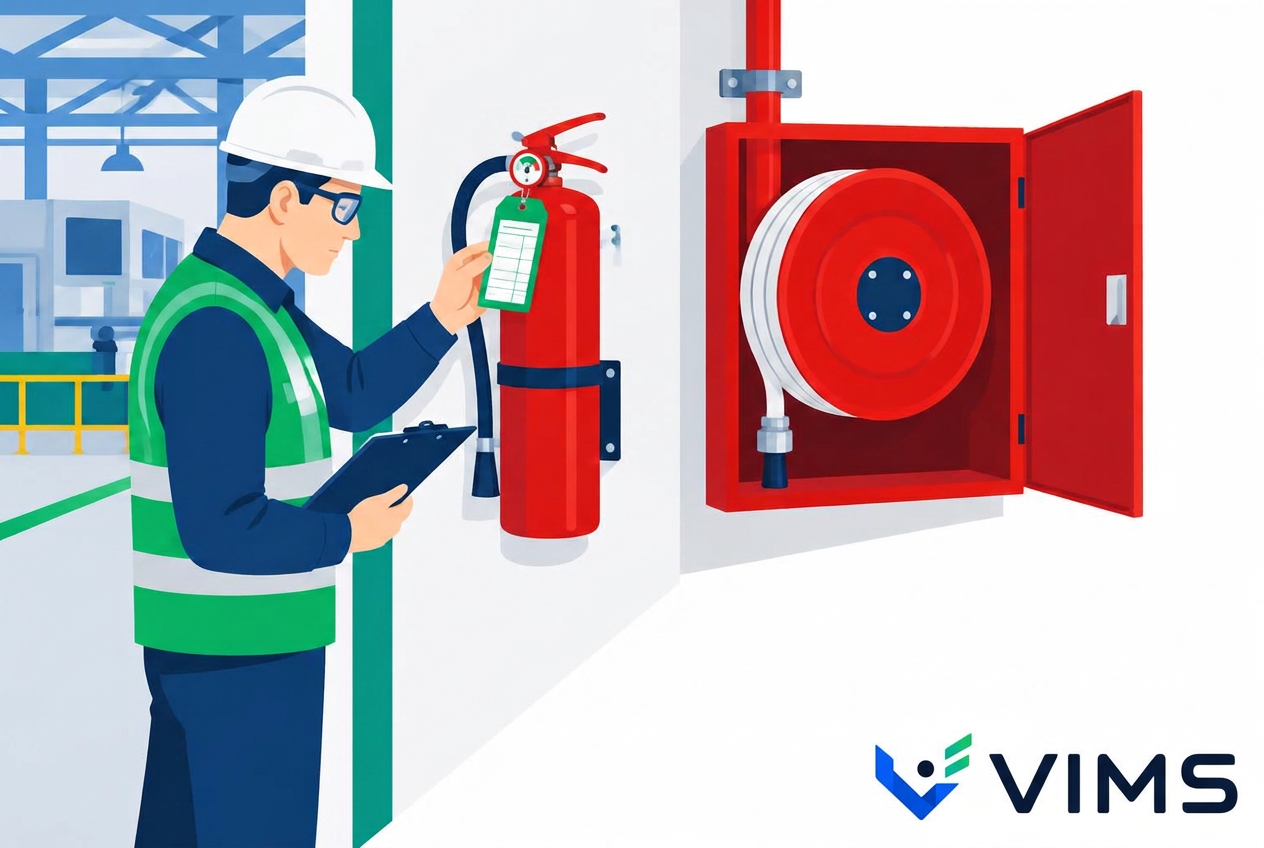
Fire extinguisher and indoor hydrant inspection — helmeted worker checking the inspection tag on a powder extinguisher next to an open hydrant hose reel cabinet — VIMS EHS illustration
Fire extinguisher and indoor hydrant inspection — helmeted worker checking the inspection tag on a powder extinguisher next to an open hydrant hose reel cabinet — VIMS illustration

1. How often to service extinguishers

Short answer: extinguishers undergo periodic servicing — as a rule at least once a year, and more often in harsh environments (humidity, corrosion, dust, extreme temperatures), per the manufacturer's instructions and fire regulations. Servicing may be performed only by an authorised provider — not by a site employee.

On top of that, roughly every 5 years extinguishers undergo an agent replacement or pressure test per the standard and manufacturer, and cylinders have their own test intervals. Practical conclusion: one extinguisher carries several deadlines at once — annual service, agent interval, cylinder test — and each must be tracked separately.
2. The extinguisher nameplate — what to read

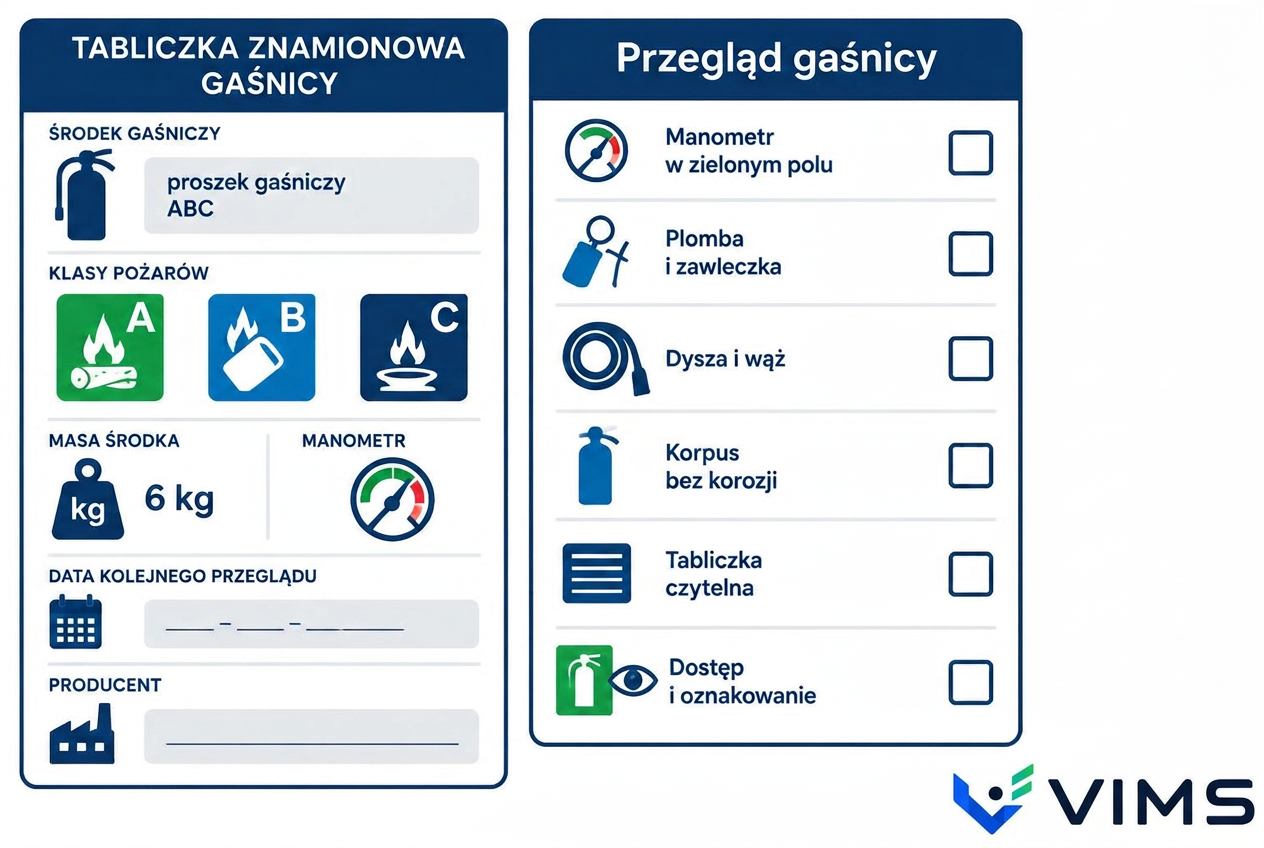
Short answer: the label of an EN 3-compliant extinguisher shows the agent type (powder, CO₂, foam), the fire classes it suits (A, B, C, D, F), agent mass or volume, operating temperature range, manufacturer details and the standard marking. This determines whether the extinguisher fits the hazards of its location — a powder ABC unit at a flammable-liquids station, a CO₂ unit at an electrical switchboard.

During an inspection check label legibility — a damaged or missing plate means nobody knows what is inside or what it is for. In the register record the unit number, type, mass, fire classes, location and dates: last service, next service and agent replacement due.

Fire extinguisher nameplate with fire classes A B C, agent mass and pressure gauge next to a sample inspection checklist: gauge in green zone, seal and pin, nozzle, corrosion-free body, access — VIMS EHS illustration
Extinguisher nameplate elements and a sample interim-check scope (illustrative image).

3. Extinguisher checklist — what to check between services

Short answer: between authorised services the site should run its own simple checks — gauge needle in the green zone (for gauged units), intact seal and pin, working nozzle and hose, corrosion- and dent-free body, legible label, and clear access with proper signage. Such a check fits in a minute per unit.

In practice the most common defects are not missing extinguishers but blocked access (pallets, carts, boxes), a seal removed after someone 'checked if it works', and a unit hung too high or moved without updating the signage. Access and signage checks combine naturally with regular site walkthroughs.

4. Indoor hydrants — scope and intervals

Short answer: indoor hydrants undergo periodic servicing — as a rule an annual inspection covers the cabinet, hose (unrolled and checked), valve, nozzle and signage, and every 5 years hoses undergo a hydraulic test. Periodic checks of system performance and pressure come on top.

As with extinguishers, an authorised provider services the hydrant, but the owner is responsible for access and everyday condition: the cabinet must not be locked without a quick way to open it, blocked, or used as storage. Report any hydrant defect immediately — it is equipment firefighters and staff rely on in a fire.

5. Fire equipment register in VIMS

In the Registers and inspections module every extinguisher and hydrant has a card with its number, type, location and all deadlines: annual service, agent replacement, cylinder or hose test. The system shows what expires this month — one service visit can be planned instead of several.

Fire point locations are worth linking to the Maps and zones module, where extinguishers and hydrants appear on the site map next to escape routes — during a round the inspector scans the point on site and ticks the checklist on a phone. A defect can immediately become a report with a removal deadline, and the service record is ready to show at an inspection. VIMS organises the register and deadlines — servicing itself is done by an authorised provider.

6. Glossary: maintenance, hose pressure tests, hydrant flow and pressure-vessel supervision

Maintenance of fire protection equipment and extinguishers follows Polish Standards and the manufacturer's instructions, at intervals set by the manufacturer but at least once a year — as required by the Polish Interior Minister's regulation of 7 June 2010 on fire protection of buildings. In Poland this is often loosely called “extinguisher legalisation”, but formally it is servicing and maintenance.

Type 25 hose reels (semi-rigid hose), type 52 hydrants (layflat hose) and landing valves are checked under the EN 671 series; in practice this means an annual inspection and a hose pressure test at maximum working pressure at least every 5 years. External hydrants (above and below ground) need periodic flow and pressure testing of the fire water supply.

Pressure-vessel supervision (UDT) applies to some vessels — including CO₂ extinguisher cylinders, which require periodic testing; the test date is stamped on the cylinder. The extinguishing agent has its own shelf life, and an expired disposable extinguisher is replaced rather than serviced.

Extinguisher placement follows the Polish regulation: at least one unit of agent (2 kg or 3 dm³) per 100 m² of fire zone area, with a walking distance to an extinguisher of no more than 30 m. The fire equipment sign (ISO 7010) marks its location — keep it on the site safety map and tag inspection points with QR codes or NFC.

Fire equipment inspections — intervals at a glance

Typical intervals. Always check current regulations and the manufacturer's instructions.

EquipmentActivityTypical intervalPerformed by
Extinguisherinspection / servicingat least yearly (more often in harsh conditions)authorised provider
Extinguisheragent replacement / testevery 5 years (per standard and manufacturer)authorised provider
Indoor hydrantinspection / servicingat least yearlyauthorised provider
Hydrant hosehydraulic testevery 5 yearsauthorised provider
All fire equipmentaccess and signage checkregularly, e.g. during walkthroughsdesignated site person

Key takeaways

  • Annual extinguisher and hydrant servicing is done by an authorised provider — the site tracks deadlines, access and records.
  • One extinguisher carries several deadlines: service, agent, cylinder — track each separately.
  • The nameplate states the fire classes the unit suits — an illegible label is a defect.
  • The most common nonconformity is not missing equipment but blocked access and a removed seal.

Frequently asked questions

How often should extinguishers be serviced?

As a rule at least once a year, more often in harsh conditions (humidity, dust, corrosion). Every 5 years the unit undergoes agent replacement or testing. Servicing is done by an authorised provider.

Who can service extinguishers?

Only a provider authorised for fire equipment servicing. A site employee may run own access and condition checks, but not the certification service.

How often are indoor hydrants inspected?

A service inspection at least once a year (cabinet, hose, valve, signage), and a hydraulic hose test every 5 years.

What do the letters A, B, C on an extinguisher mean?

Fire classes the agent suits: A — solids, B — liquids, C — gases (plus D for metals and F for cooking fats). The extinguisher is selected for the hazards of its location.

Can an extinguisher be locked in a cabinet?

Access to firefighting equipment must be free and quick. A cabinet locked with a key nobody has during an event is a nonconformity — break-glass panels or marked enclosures are used instead.

How often are fire hose pressure tests required?

Under the EN 671 series, hoses are tested at maximum working pressure at least every 5 years, in addition to the annual hydrant inspection.

How many extinguishers does a workplace need?

Under Polish rules, at least one unit of agent (2 kg or 3 dm³) per 100 m² of fire zone, with no more than 30 m to the nearest extinguisher. The type is chosen to match the hazards.

Are CO₂ extinguishers subject to pressure-vessel supervision?

CO₂ cylinders require periodic pressure testing under technical supervision; the test date is stamped on the cylinder. The annual service is done by a qualified provider.

All fire safety deadlines in one register

See how VIMS keeps the extinguisher and hydrant register with deadlines, a fire point map and phone checklists.