

VIMSVIMS

Lockout/Tagout (LOTO) in practice: energy isolation procedure, LOTO card and choosing lockout devices

Lockout/tagout (LOTO) is a procedure that, before maintenance, cleaning or clearing jams, isolates every energy source of a machine, secures it with a personal padlock and tag, and confirms through a try-out that the equipment cannot start unexpectedly or release stored energy.

A guide for maintenance, safety and production managers: how to prepare a LOTO card for a specific machine, how to isolate energy in 6 steps, which devices fit which energy sources and how to organise LOTO when several crews work together.

  • LOTO
  • lockout tagout
  • LOTO card
  • energy isolation
  • lockout devices
  • maintenance

Published: 2026-10-04 · Updated: 2026-10-04 · 14 min read · Varilo deployment team

Maintenance technician applying a LOTO padlock and tag to a machine main isolator

Why LOTO: unexpected start-up and stored energy

Most serious machine accidents during maintenance share a scenario: someone started the machine without knowing a fitter was inside; the drive was stopped but the cylinder was not depressurised; the conveyor stopped but the ram dropped under its own weight. Pressing STOP or switching off at the panel is not isolation — it is just a command to the control system.

LOTO turns that command into a physical barrier. Each energy source is disconnected by an isolating device that can be locked in the off position, and only the person doing the work holds the key. The tag shows who locked the device, when and why.

Energy is not only electricity. A LOTO card must cover electrical, pneumatic, hydraulic, mechanical (springs, flywheels), gravitational (raised parts), thermal and chemical energy (media in pipes), plus energy stored in capacitors and hydraulic accumulators.
Legal background and standards

In the EU, Directive 2009/104/EC on the use of work equipment requires maintenance to be carried out with equipment shut down and work equipment to have clearly identifiable means of isolation from each energy source that can be secured. Machine design guidance is given by EN ISO 14118 on prevention of unexpected start-up. In the US, OSHA 29 CFR 1910.147 — the origin of the lockout/tagout term — sets detailed requirements often adopted by global groups.

Electrical work has its own rules for preparing the workplace: disconnect, secure against reconnection, verify absence of voltage, earth and mark. National regulations transpose these principles differently.

This overview is for information only and is not legal advice. Requirements for a given machine follow from the employer's risk assessment and manufacturer documentation.

The LOTO card: preparing it for a specific machine

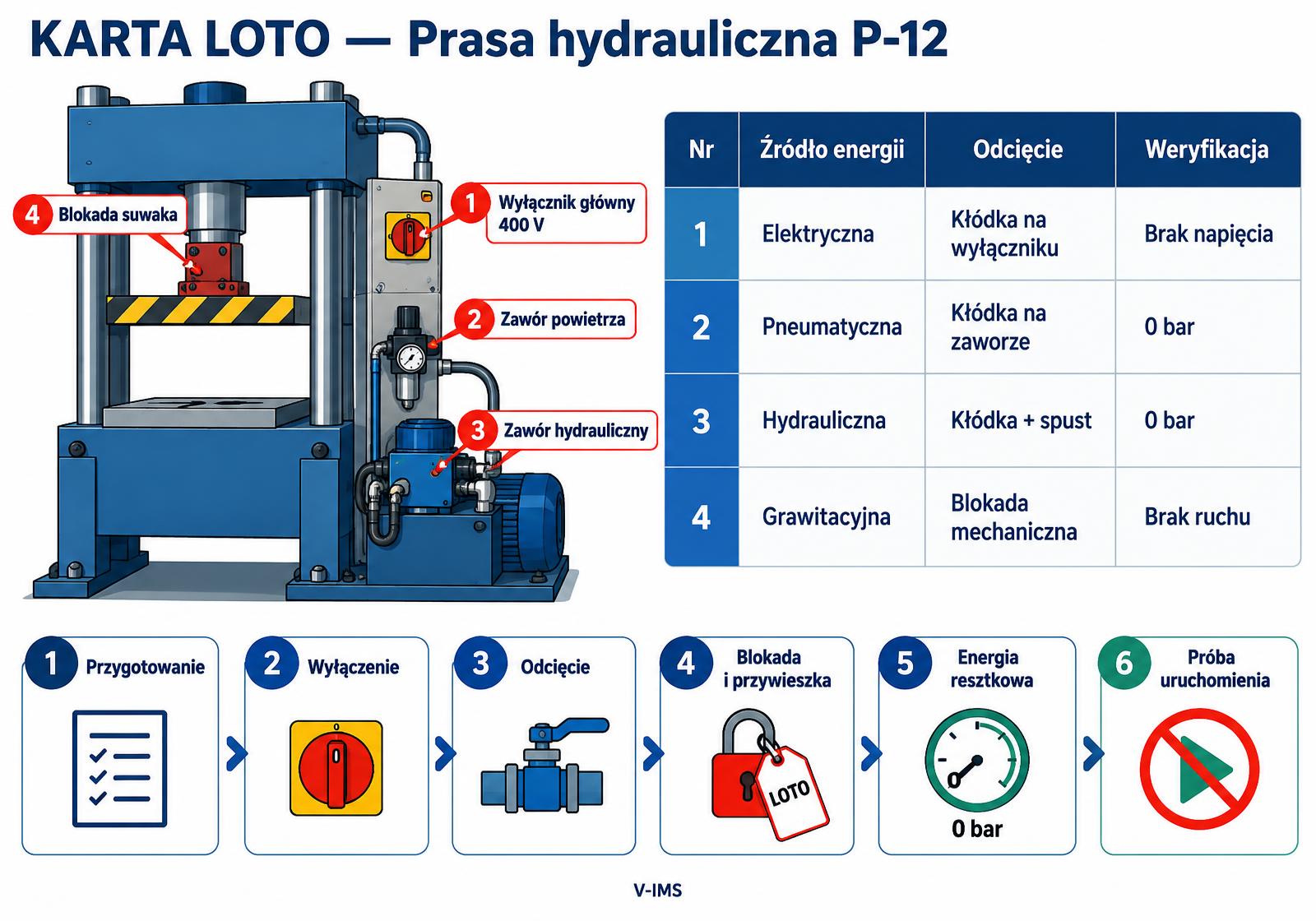
A LOTO card (energy isolation procedure) belongs to one machine or line. It shows a photo or diagram with numbered isolation points, a table of energy sources, the isolating device, the required lock and how to verify zero energy — such as testing for absence of voltage, reading 0 bar on a gauge or checking the ram is mechanically blocked.

A good card is short, visual and posted at the machine. Nobody should look for isolation points from memory or in a binder in the office. Maintenance and safety prepare the card together, and every modification — a new valve, an extra drive, a changed supply — requires an update.

In the example, a hydraulic press has four energy sources: 400 V supply, compressed air, hydraulics with a pressure accumulator and a ram that can drop under gravity. Missing any point means isolation is incomplete.

Sample LOTO card for a hydraulic press with four energy isolation points and a 6-step procedure (Polish labels)
Sample LOTO card (Polish labels): electrical, pneumatic, hydraulic and gravitational isolation points and the 6 procedure steps.

The LOTO procedure in 6 steps

1. Prepare — identify the machine, open its LOTO card, determine all energy sources and notify operators and anyone whose work will stop.

2. Shut down — stop the machine normally according to its instructions without creating additional hazards (e.g. finish the cycle, clear the area).

3. Isolate — disconnect each energy source with an isolating device: main switch, isolation valve, gate valve. A STOP button, control switch or light curtain is not an isolating device.

4. Lock and tag — each person working on the machine applies their own padlock with a unique key and a tag with name, date and reason. With several isolation points or workers, use a multi-lock hasp or a group lock box.

5. Release stored energy — bleed pressure, vent air lines, discharge capacitors, block or lower raised parts, wait for rotating parts to stop and hot surfaces to cool.

6. Verify (try-out) — make sure nobody is in the danger zone and try to start the machine from the panel; test for absence of voltage, check gauges. Return the controls to off afterwards. Only now may work begin.

Return to service follows the reverse order: tools removed, guards refitted, people clear of the area, operators informed, locks removed — each lock only by the person who applied it.

Types of lockout devices and tags

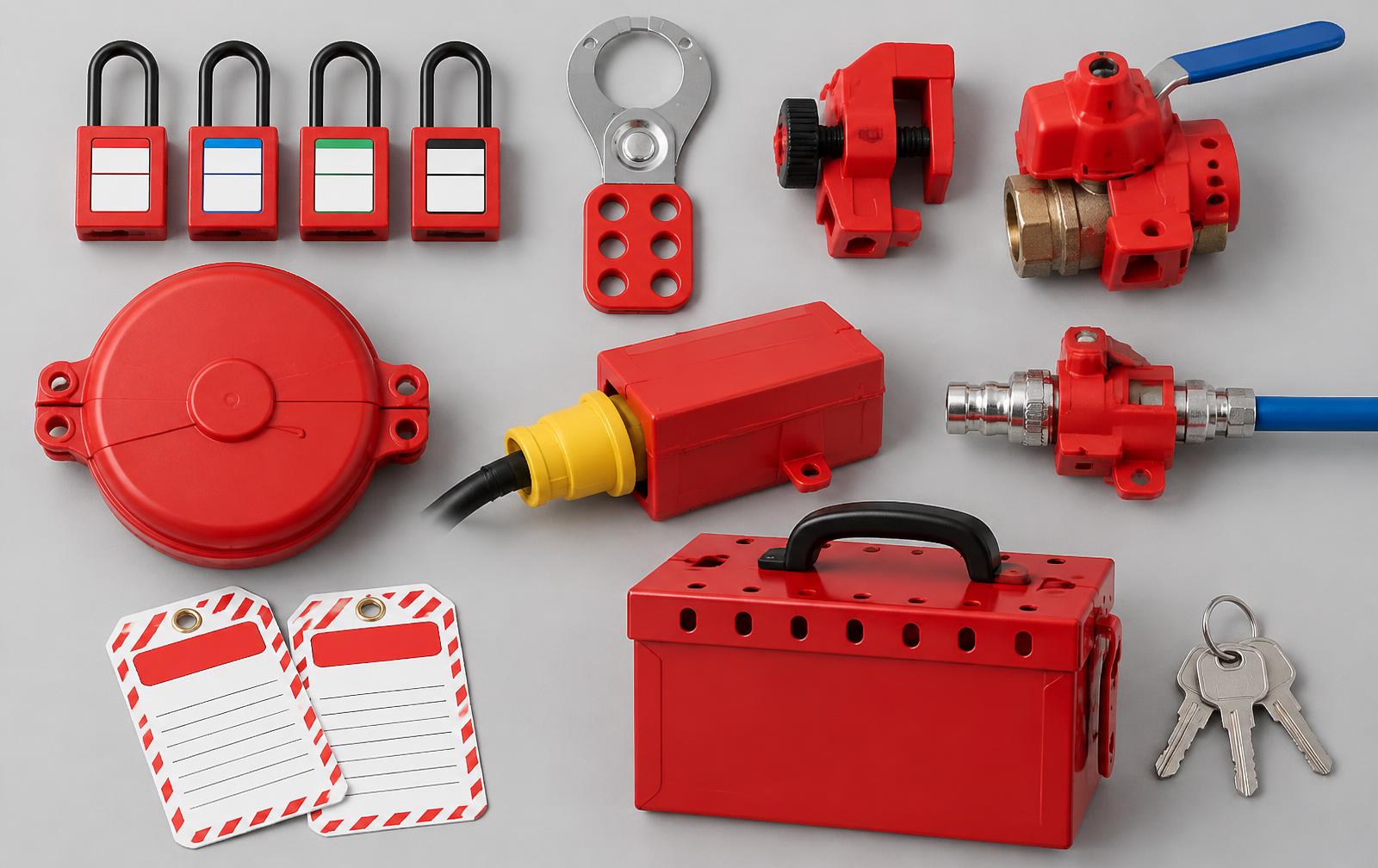
LOTO padlocks are personal, one key per lock, often with a non-conductive shackle and a name label. Colours can identify departments (maintenance, electricians, contractors) — agree one scheme for the whole site.

Padlocks are combined with adapters: circuit breaker lockouts, plug lockouts, ball and gate valve lockouts, pneumatic coupling lockouts. A multi-lock hasp lets several people lock the same point. A group lock box is used for larger jobs: keys from the isolation-point locks go into the box and each crew member puts a personal lock on it.

A tag without a lock (tagout only) is merely a warning, not a physical barrier. It is used only where a device cannot be locked, with additional measures from the risk assessment, and the isolating device should eventually be upgraded to accept a lock.

Types of LOTO devices: personal padlocks, multi-lock hasp, valve, breaker and plug lockouts, tags and a group lock box
A typical LOTO kit: personal padlocks, multi-lock hasp, valve, breaker, plug and coupling lockouts, tags and a group lock box.

Common LOTO mistakes

Isolating only electricity and forgetting pressure, springs or gravity. Skipping the try-out because "I switched it off". One shared lock for the whole shift or a key left in the lock. Removing someone else's lock at shift handover without a defined procedure.

LOTO cards that no longer match the machine after modification. Contractors arriving with their own rules and no idea where isolation points are. No training distinguishing roles: the authorised person (performs LOTO) and the affected person (must understand what not to touch).

The emergency removal of an absent person's lock must be defined in advance: who may do it, after which contact attempts, with what machine check and how it is documented.

How V-IMS supports LOTO on site

V-IMS does not replace physical locks — it brings order around them. In the Permit to Work (PTW) module, electrical and maintenance work with energy isolation has its own category: permit conditions include performing and confirming isolation, and the permit is not approved until the required points are confirmed by the responsible people.

In Registers and inspections every machine has a record where you can attach the current LOTO card and manufacturer documentation, with reminders for inspections. Training records show who holds valid LOTO training, and permits for external companies include contractor document checks.

If a near miss occurs — for example a machine moved despite a lock — the worker reports it from a phone, and root cause analysis and corrective actions (CAPA) land in one register, together with the decision to update the LOTO card.

Lockout, tagout or just a switch? Comparing protection methods

Only full LOTO with verification creates a confirmed physical barrier against start-up.

MethodWhat it doesPhysical barrierWhen acceptable
STOP / panel switch-offStops the machine via the control systemNone — it can be restartedNormal operation, never as protection for maintenance
Tagout (tag only)Warns that equipment is disconnectedNone — information onlyExceptionally, where a point cannot be locked, with extra measures
Lockout (padlock)Locks the isolating device in the off positionYesMaintenance, cleaning, clearing jams
Full LOTOLock + tag + stored energy release + try-outYes, with confirmed effectivenessStandard for all work in a machine danger zone
Group LOTOGroup lock box and personal locks of every crew memberYes, for each person individuallyMajor overhauls, many isolation points, several crews or contractors

Key takeaways

  • STOP is not isolation — LOTO needs an isolating device locked with a padlock.
  • A LOTO card must cover every energy type, including pressure, springs and gravity.
  • Each worker applies a personal lock and only they remove it.
  • The try-out is a mandatory step, not a formality.
  • Update the LOTO card after every machine change.
  • V-IMS links LOTO with permits to work, machine records, training and CAPA.

Frequently asked questions

What does LOTO stand for?

Lockout/Tagout — physically locking energy isolating devices with a padlock and marking them with a tag showing the responsible person.

Is LOTO mandatory?

EU rules require maintenance on shut-down equipment that can be isolated and secured from each energy source; in the US OSHA 1910.147 requires it explicitly. LOTO is the practical way to meet these requirements.

Who may remove a LOTO lock?

Only the person who applied it. Removal in their absence needs a predefined emergency procedure and documentation.

How does LOTO differ from a permit to work?

LOTO is technical energy isolation at a specific machine. A permit to work is formal authorisation for hazardous work, which often requires LOTO as one of its conditions.

Does V-IMS control lockout devices?

No. Locks are physical. V-IMS organises the documentation: permits with isolation conditions, LOTO cards on machine records, training, contractors and actions after incidents.

Bring LOTO and permits to work into one system

We show how a permit with an energy isolation condition, the machine record and training records work together in V-IMS.