VIMS EHSVIMS EHS

Ladder inspections — how often, what to check and how to document them

A ladder is everyday equipment whose failure ends in a fall from height. Regulations require equipment to be kept in safe working order, and the EN 131 standard defines ladder design and marking requirements. Practice shows the best scheme is simple: a pre-use check by the user plus a periodic, documented inspection against a checklist.

This guide shows how to read a ladder's rating plate, what an inspection checklist should cover and how to build a record that stands up to an audit — without a binder full of slips.

  • Ladder inspections
  • EN 131
  • Inspection checklist
  • Equipment register
  • Technical condition

Published: 2026-10-26 · Updated: 2026-11-01 · 8 min read · Varilo deployment team

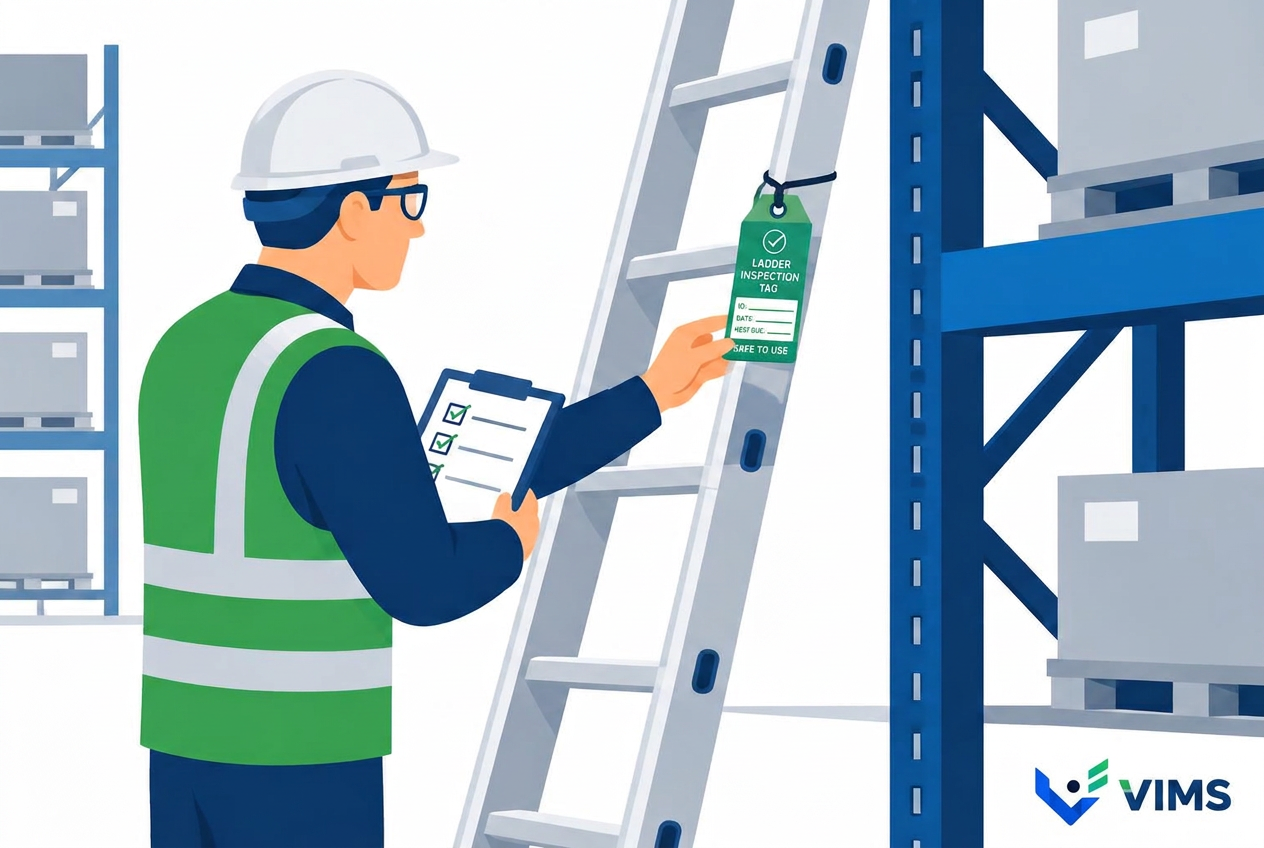
Industrial ladder inspection EN 131 — helmeted worker checking a ladder with a green inspection tag next to warehouse racking — VIMS EHS illustration
Industrial ladder inspection EN 131 — helmeted worker checking a ladder with a green inspection tag next to warehouse racking — VIMS illustration

1. Why ladders need systematic inspections

Short answer: ladders wear invisibly — a cracked rung, worn hinges or abraded anti-slip feet only reveal themselves under load. Falls from ladders are among the most frequent accidents in production plants and warehouses.

General OSH regulations require equipment to be maintained in a condition that ensures safe use, and ladders to be set up stably on even ground at the correct angle. The employer should designate persons responsible for equipment condition and a way of documenting checks. A verbal 'be careful with ladders' will not hold up during a labour inspection.

2. The rating plate and EN 131 marking — what to read

Short answer: every EN 131-compliant ladder carries durable marking with the standard symbol, maximum load (at least 150 kg for professional ladders), ladder type and manufacturer details. This is the first checkpoint of every inspection — if the marking is illegible, you do not know what equipment is actually in service.

Distinguish domestic ladders from professional ones and verify the class and declared load. A ladder bought in a hurry at a DIY store, without legible EN 131 marking, should not serve regular workplace tasks. In the equipment register record the serial or internal number, type, purchase date and a photo of the plate — it makes every subsequent inspection easier.

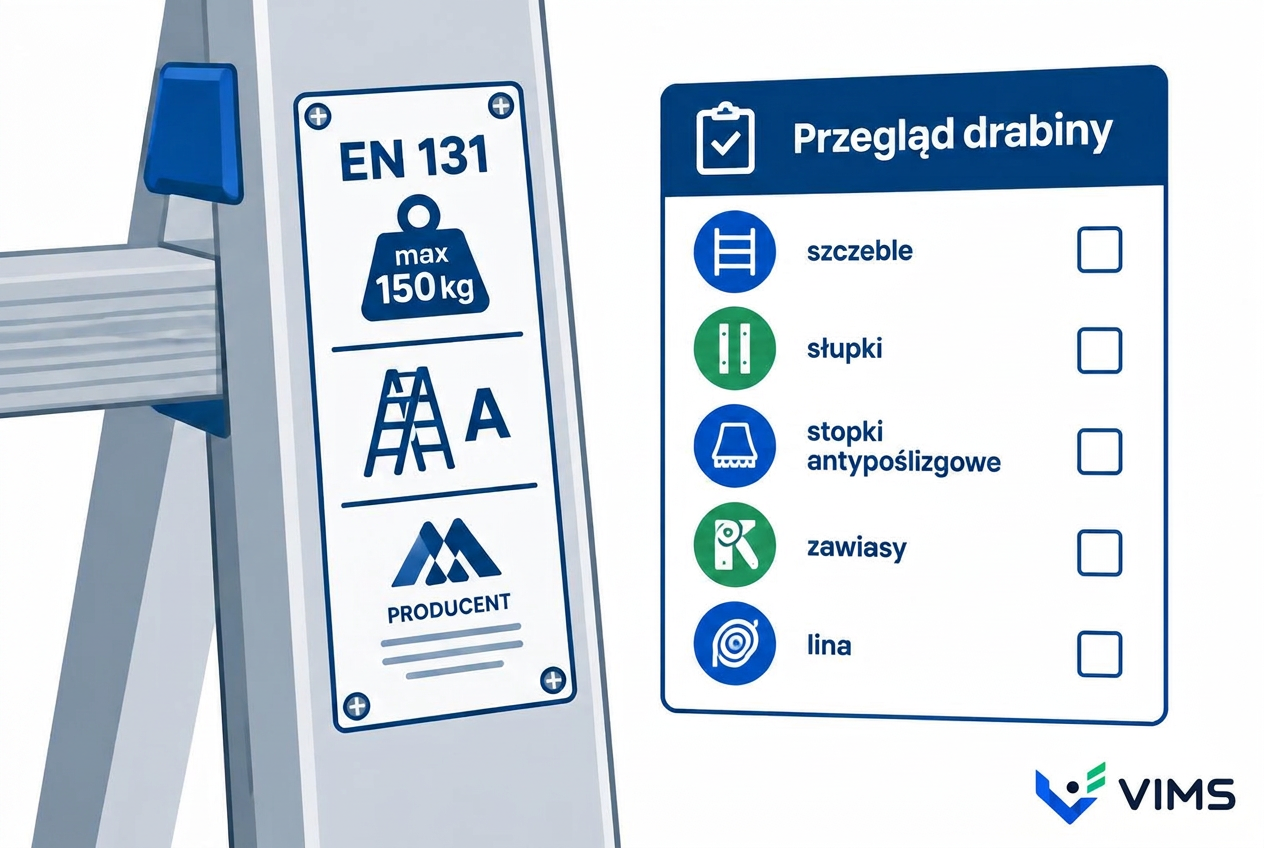
EN 131 ladder rating plate with 150 kg maximum load and ladder class next to a sample inspection checklist: rungs, stiles, anti-slip feet, hinges, rope — VIMS EHS illustration
EN 131 marking on a ladder stile and a sample checklist scope for periodic inspection (illustrative image).

3. How often should ladders be inspected

Short answer: regulations do not set one calendar date for all ladders — the duty is to keep them serviceable, so frequency is based on the manufacturer's instructions, intensity of use and working conditions. A two-level scheme works well: a quick pre-use check by the user plus a documented periodic inspection.

For ladders used daily in a warehouse or production, a monthly or quarterly inspection is a sensible standard; rarely used equipment may be inspected less often, but always after any event that could damage it (a fall, forklift impact, transport). What matters is that the frequency is written down and actually followed — not checked only 'on holidays'.

4. Ladder inspection checklist — what it should cover

Short answer: a good checklist covers rungs and steps (cracks, deformation, looseness), stiles (dents, corrosion), anti-slip feet (completeness, wear), hinges and locks on stepladders (operation, securing), the rope and hooks on combination ladders, and legibility of markings. For tall ladders — additionally guide rails and stops.

Build the checklist as yes/no items with room for notes and a photo of the defect. A damaged ladder must be immediately tagged and withdrawn from use — merely writing 'to repair' without physically securing the equipment is the most common mistake. Such a template can be kept in the system as a repeatable inspection form for every ladder in the register.

5. Inspection records in VIMS — from paper slips to a status list

In the Registers and inspections module each ladder has an equipment card with a number, location and inspection schedule. The system shows which inspections are done, expiring or overdue — instead of digging through a binder of protocols before an audit.

The inspector ticks the checklist on a phone, can attach a photo of a defect, and a detected fault can immediately become a report in the Hazard reports module with an assigned owner and deadline. The Inspections and walkthroughs module additionally verifies ladder condition during routine rounds. VIMS organises the register and deadlines — the inspection itself is performed by the person designated by the employer.

6. Glossary: EN 131, professional ladders, competent person and withdrawal criteria

EN 131 is a multi-part ladder standard: part 1 — types and sizes, part 2 — requirements, testing and marking, part 3 — marking and user instructions, part 4 — single or multiple hinge-joint ladders; further parts cover telescopic ladders and mobile platforms. Since the 2017/2018 revision, the standard distinguishes professional and non-professional (domestic) ladders — both rated at 150 kg but tested to different strength and durability levels. Use professional ladders at work.

Leaning ladders, stepladders, combination (hinged) ladders and platform stepladders are set up differently and carry different risks, so record the ladder type, not just “ladder”. Leaning ladders are set at roughly 65–75°, and the top should extend at least 0.75 m above the landing edge. Wide ladders longer than 3 m usually require a stabiliser bar.

A competent person is someone appointed by the employer who knows the standard, the manufacturer's instructions and the assessment criteria — there is no separate statutory “ladder inspection licence” in Poland. A pre-use check (visual, by the user) differs from a periodic inspection (documented) and an ad hoc check after an event such as a fall or a forklift impact — see forklift inspections.

Withdrawal criteria are the conditions that send a ladder for repair or scrapping: a cracked or bent rung, a deformed stile, a missing anti-slip foot, a faulty lock or spreader, illegible marking. Tag a withdrawn ladder and move it to a designated area; linking the inspection date to an asset tag is easiest — see QR codes and NFC in safety.

Levels of ladder control in a workplace

A practical scheme combining user checks with documented periodic inspections.

Control levelWhoWhenDocumentation
Pre-use checkladder userbefore every usenot required — visual assessment
Periodic inspectiondesignated person (OSH, maintenance)per schedule, e.g. monthly/quarterlychecklist with result, notes and photos
Extraordinary checkdesignated personafter a fall, impact, transport or repairprotocol + decision on return to service or withdrawal

Key takeaways

  • The pre-use check is the user's duty; the periodic inspection is a documented task of a designated person.
  • The EN 131 plate with the declared load is the first checkpoint — illegible marking means withdrawing the equipment.
  • The checklist should cover rungs, stiles, feet, hinges and markings, with room for a defect photo.
  • A damaged ladder must be physically tagged and withdrawn, not just noted in a protocol.

Frequently asked questions

How often should a ladder be inspected?

Regulations set no single date — frequency follows the manufacturer's instructions and intensity of use. In practice, daily-used ladders are inspected monthly or quarterly, complemented by a pre-use check.

Who can perform a ladder inspection?

A person designated by the employer who knows the standard's requirements and inspection scope — typically an OSH or maintenance worker. The inspection should be documented.

What does EN 131 on a ladder mean?

Compliance with the European ladder standard. The marking includes the standard symbol, maximum load (at least 150 kg for professional ladders), ladder type and manufacturer.

What to do with a damaged ladder?

Withdraw it immediately and tag it physically (tag, tape, quarantine storage). It returns to service only after repair and re-inspection — otherwise it should be scrapped.

Does a pre-use check replace a periodic inspection?

No. The pre-use check is the user's visual assessment, while the periodic inspection is a documented checklist review by a designated person. The two levels complement each other.

Do you need a licence to inspect ladders?

There is no separate statutory licence in Poland. Inspections are carried out by a competent person appointed by the employer who knows EN 131, the manufacturer's instructions and the withdrawal criteria.

What is the difference between professional and domestic ladders under EN 131?

Both are rated at 150 kg, but professional ladders are tested to higher strength and durability requirements. Use professional ladders in the workplace.

Should the inspection date be marked on the ladder?

It is not legally required, but a sticker or tag with the date and number speeds up pre-use checks. A QR code pointing to the current inspection result is even more practical.

Track inspection deadlines without a binder

See how VIMS keeps the equipment register, inspection schedules and phone checklists — for ladders, racking, extinguishers and the whole site.