
Safety conversations — the cheapest source of insight into what really blocks safe work

Few workers fill in a form to say that a guard gets in the way or that a procedure is unrealistic at the current pace. They will say it in a short conversation at the machine. This module structures those conversations and turns them into usable knowledge.

  • Safety talks
  • Behaviour based safety
  • Safety culture
  • Workplace briefings
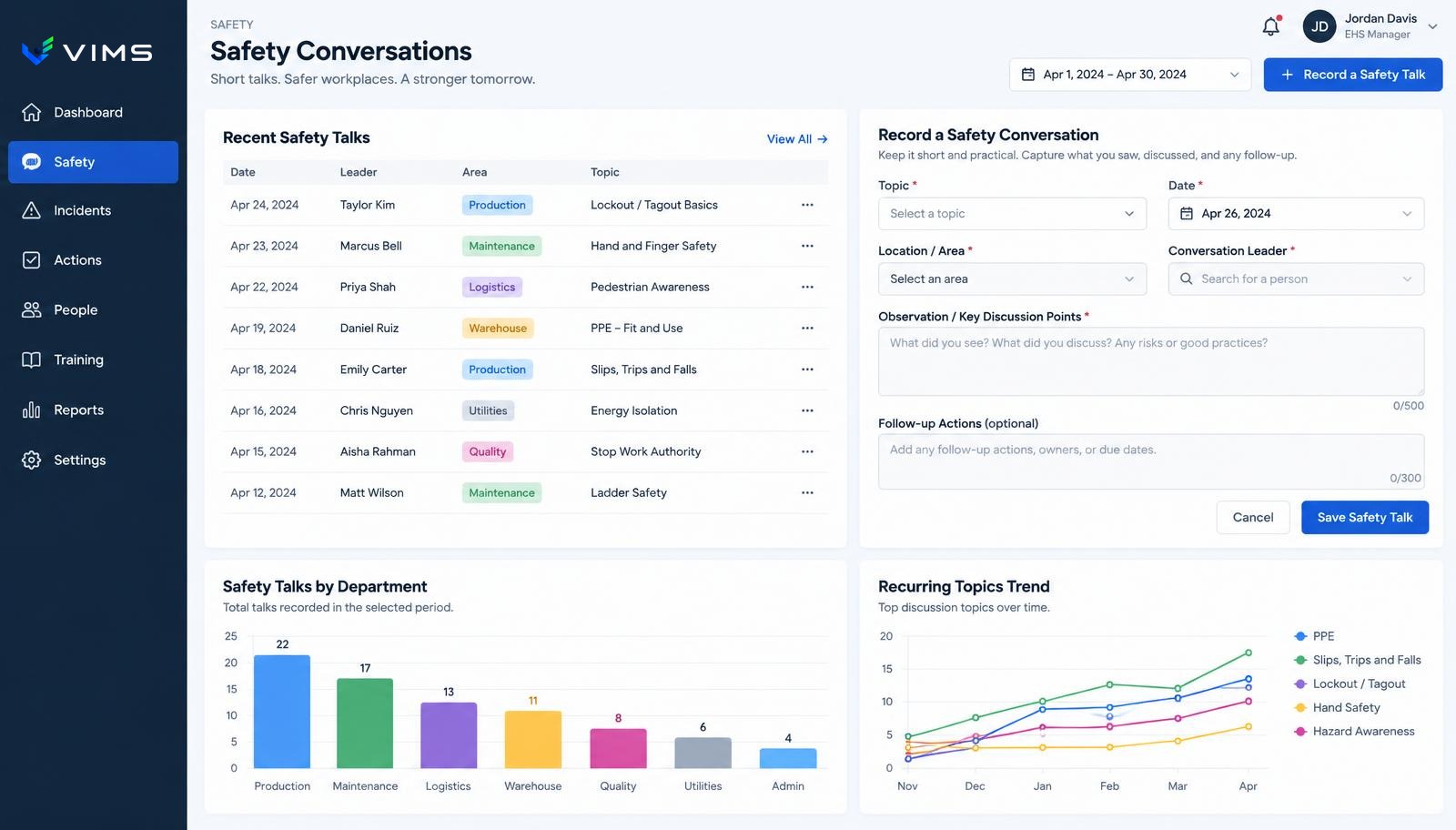
V-IMS — safety conversations module showing recorded talks with topic and area, an observation capture form and a chart of recurring discussion topics

A conversation says what no form ever will

Reporting systems and inspections show a state: a missing guard, a blocked walkway, an unlabelled container. They do not answer why it is like that. The person doing the work almost always knows, and the simplest way to find out is a short conversation at the workplace, held without looking for someone to blame.

In practice the reasons are mundane: the right tool is two hundred metres away, the procedure was written for a different machine version, respiratory protection makes communication impossible in noise, and the missing minute in the cycle decides the bonus. None of that will ever appear in a nonconformity register.

A safety conversation is therefore a diagnostic tool, not a control tool. Its output is not a reprimand but a record: what was observed, what the worker said, which barrier was named and what happened next.

Brevity is the condition for it working. The talk lasts a few minutes and recording it should take just as little — otherwise managers stop holding them, or fill in a month's worth at once, which destroys the whole point.

From one conversation to a picture of the organisation

One conversation is an anecdote. A hundred conversations in a quarter are data. Only the aggregate shows that hearing protection keeps coming up in three departments, and that remarks about time pressure cluster on one shift and one work cell.

In VIMS a talk is recorded with a topic, area, leader and a short observation. That structure allows later filtering and comparison without forcing anyone to write an essay. Both recurring topics and areas where nobody has spoken to people for months become visible.

The second indicator is often the most revealing. If the department with the most incidents also has the fewest recorded conversations, the problem is not worker awareness but supervisor presence on the floor.

What the Safety conversations module gives you

Short conversation record

Topic, area, leader and observation in a few fields — no lengthy protocol.

Topic library

Ready-made talk topics tied to job roles, season and current hazards on site.

Manager activity plan

Expected number of talks per person and area, with completion visible.

Findings with a consequence

A named barrier can become a task instead of staying a note in a notebook.

Recurrence analysis

Topics returning in the same area and how the trend changes over time.

Documentation without penalties

The record supports analysis and prevention, not building a case against a worker.

How a safety conversation flows

A conversation makes sense when the worker sees the result, so it ends with feedback rather than filing.

  1. 1Talk plan for managers and areas
  2. 2Conversation at the workplace
  3. 3Observation and barrier recorded
  4. 4Finding passed to a task or report
  5. 5Feedback given to the worker
  6. 6Recurring topics analysed

Why a conversation must not become a disciplinary tool

The moment the record starts being used to issue reprimands, its usefulness ends. Workers learn very quickly which answers are safe, and from then on every conversation confirms that everything is fine.

The record in VIMS therefore focuses on the barrier and the working conditions, not on judging a person. Instead of a "violation" field there is a "what makes safe execution harder" field. A small difference on paper, but it decides whether the tool becomes a source of information or another formality.

The practical test is what the records look like after six months. If most read "worker did not wear glasses", the talks have turned into inspections. If they describe work organisation, tools, communication and time pressure, the tool is doing its job.

Connected to the rest of the system

A conversation is often the first place a problem surfaces that later appears as a report or an incident. A finding can therefore be passed on: as a hazard report, a maintenance task or a trigger to review the risk assessment for that workplace.

It works the other way too. After an incident or a run of reports from one area, conversations become the way to check whether the changes actually work in daily practice rather than only in the documentation. Asking at the workstation whether the job is now faster and safer verifies effectiveness better than a closed status in a system.

Conversation summaries are also material for management review: they show leadership engagement in numbers rather than declarations.

Frequently asked questions about safety conversations

How is a safety conversation different from a workplace briefing?

A briefing passes on requirements and the way work should be done; a conversation explores reality and barriers. A briefing is one-way, a conversation two-way — its output is feedback from the worker.

How many conversations should one manager hold?

A few short talks per person per month works well in practice. Regularity matters more than volume: four talks every month achieve more than twenty held in the last week of the quarter.

Does the record have to name the worker?

The record focuses on the observation and the barrier rather than on assessing a person. How participants are identified is an organisational decision — what matters is that the record never becomes grounds for sanctions.

Can a conversation lead to an action?

Yes. A named barrier can be passed on as a task with an owner and due date, or as a hazard report when it needs wider analysis.

How do you measure whether conversations work?

Three indicators are most useful: completion of the talk plan by managers, the number of findings converted into actions, and how recurring topics change across quarters.

Does the module suit behaviour based safety observations?

Yes. The record covers observation, conversation and conclusion, which matches the logic of behavioural observations run without a penalty system.

Related modules

Hazard reporting

The cheapest information in a plant is the one that arrives before an accident. This module shortens the path from spotting a hazard to deciding on an action, and makes sure the reporter hears back.

Hazard reporting

Rounds and inspections

A safety walkaround is a cheap prevention tool, but only when it happens regularly and ends with an assigned task. This module enforces both conditions.

Rounds and inspections

VIMS module

Report an event in seconds, run the root cause analysis, plan actions and close the case with complete documentation in one place.

Accidents and incidents

Turn shop-floor conversations into real knowledge about risk

Book a demo and see how a conversation is recorded and how recurring topics are analysed.