
VIMSVIMS

Safety conversations and observations: BBS, safety walks, toolbox talks and more — types, differences, practice

Safety conversations are short, planned or spontaneous contacts between supervisors, EHS staff and workers at the workplace, aimed at spotting at-risk behaviours and conditions, recognising good practice and agreeing specific improvements. Several methods are used in practice — from behaviour-based safety (BBS) observations, through leadership walks, to morning toolbox talks — differing in purpose, frequency and who leads the conversation.

Few people fill in a form. Almost everyone will talk at the machine — if they know nobody is looking for someone to blame and that the problem they raise will actually be fixed.

  • BBS
  • Safety walk
  • Toolbox talk
  • Gemba walk
  • Safety culture

Published: 2026-10-01 · Updated: 2026-10-01 · 11 min · Varilo deployment team

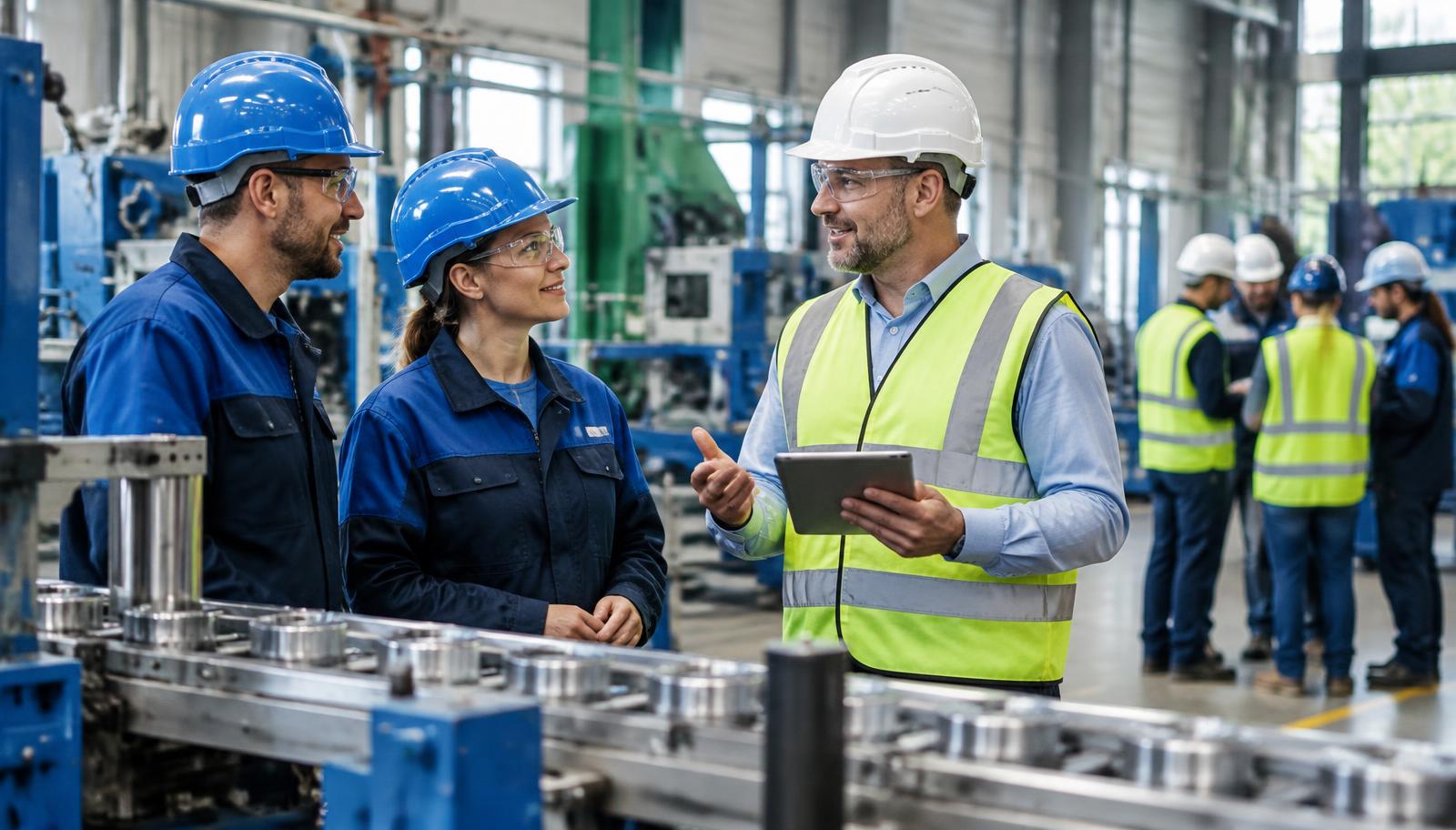
EHS manager with a V-IMS tablet holding a safety conversation with operators at a production line, a toolbox talk in the background

Why talk about safety when there are procedures?

Procedures describe how work should be done. A conversation shows how it is really done: the guard gets in the way during changeover, the instruction does not cover the new material, end-of-shift pace forces shortcuts. These signals never appear in an accident report, because they show up before anyone gets hurt.

Regular conversations also build trust. A worker who sees their remark turn into real action is more willing to report the next hazard or near miss. That mechanism separates a mature safety culture from paper compliance.

ISO 45001 explicitly expects consultation and participation of workers (clause 5.4). Documented conversations and observations are among the most convincing evidence that this requirement works in practice.

BBS — Behaviour Based Safety observations

BBS is based on systematic observation of work behaviours against an agreed checklist (e.g. PPE use, body position, tool use, housekeeping). Observers are usually trained workers — often peers from the same shift rather than supervisors.

How it is done matters most: the observer first recognises safe behaviours, then asks about the reasons for at-risk ones ("what makes it easier to do it this way?") instead of reprimanding. Observations are usually anonymous with respect to the person observed — the trend matters, not the name.

The value of BBS grows with the number of observations: after a few months you can see which at-risk behaviours recur in an area and which conditions drive them. That is input for technical and organisational change, not for discipline.

Safety walk

A safety walk is a planned walk through a selected area by EHS staff, a supervisor or area manager, combined with short conversations with workers. Unlike an audit, it is not a full compliance check but a way to identify current hazards and the mood on the floor.

A good walk has a theme (e.g. traffic routes, forklift work, chemical storage), takes 20–40 minutes and ends with a list of specific actions with an owner and a deadline. Without that last step a walk quickly becomes a stroll.

Leadership walk / safety tour

A variant of the safety walk led by board members and senior managers. Its main aim is visible leadership commitment: a director asking an operator what makes safe work harder sends a stronger signal than any safety policy on the noticeboard.

The conversation should be open but well prepared — the manager knows recent incidents and CAPA actions in the area. Commitments made during the walk must be delivered and communicated back to workers.

Toolbox talk — a short pre-work briefing

A toolbox talk is a 5–15 minute team conversation before a shift or task, led by a team leader or supervisor. It covers one topic: today's specific work, lessons from a recent incident, a seasonal hazard (heat, ice) or a reminder of a rule.

As group communication, its strength is regularity and brevity. Recording attendance is worthwhile — simple evidence that the message reached everyone, also useful in a later investigation.

A toolbox talk does not replace periodic training or job instruction — it is their daily complement.

Gemba walk — going where value is created

The Gemba walk comes from lean management (gemba — "the real place"). The manager goes to the floor to understand the process, ask questions and listen, not to judge. It covers quality, productivity and safety together.

For EHS, Gemba is valuable because it reveals hazards caused by work organisation: awkward material handling, no set-down space, time pressure. Gemba findings often lead to solutions that remove risk at the source.

SOT and post-incident conversations

A Safety Observation Tour (SOT) or observation card is a simplified form in which any worker can record an unsafe condition or good practice — the line between SOT and hazard reporting is often blurred.

A post-incident conversation (debrief) takes place soon after an incident or near miss. Its purpose is to gather facts and participants' perspectives before formal root cause analysis (e.g. 5 Why). It must be blame-free — otherwise future events will not be reported.

How to hold a good safety conversation

A simple pattern works: introduce yourself and the purpose, observe the work, recognise what is done well, ask open questions about difficulties, agree an improvement together, say thank you. Avoid interrogation and lists of faults.

The follow-up matters most. A finding without an owner and deadline is an empty promise. That is why conversation findings should feed corrective actions (CAPA), and the worker should hear back about progress.

How V-IMS supports conversations and observations

The V-IMS Safety Talks module lets you record a conversation or observation on a phone or tablet right on the floor: area, topic, safe and at-risk behaviours, agreed actions and photos. An agreed action can immediately become a CAPA with an owner and deadline.

Conversation data connects with safety walks and inspections, hazard reports and risk assessment, so recurring topics per area become visible. Specific formats (BBS, safety walk, toolbox) are configured to the organisation's own standard — V-IMS does not impose one methodology.

Comparison of safety conversation and observation types

The comparison is indicative — in many sites the methods overlap and are adapted to the company's own standard.

MethodLed byPurposeFrequency / durationTypical output
BBS (behavioural observation)Trained worker observersChange behaviour, find causes of at-risk behaviourContinuous, many short observations (5–10 min)Behaviour trends, actions on work conditions
Safety walkEHS, supervisor, area managerIdentify hazards and conditions in an areaE.g. weekly, 20–40 minAction list with owner and deadline
Leadership walk / safety tourBoard and senior managementVisible commitment, dialogue with workersE.g. monthly, 30–60 minManagement commitments, cultural signal
Toolbox talkTeam leader, shift supervisorShare one message before workDaily / before a task, 5–15 minAttendance record, shared risk understanding
Gemba walkManagers (lean)Understand the process: quality, productivity, safetyRegularly, per lean standardWork organisation improvements
SOT / observation cardAny workerRecord unsafe conditions and good practiceOngoingReport, possible corrective action
Post-incident conversationSupervisor, EHSGather facts without blameSoon after the eventInput for root cause analysis and CAPA

Key takeaways

  • BBS focuses on behaviour and is mainly run by workers; safety walks and leadership walks are led by supervisors and management.
  • A toolbox talk is a short daily group briefing that complements, but does not replace, training.
  • Every conversation should start with recognition and end with a specific action with an owner and deadline.
  • Post-incident conversations must be blame-free, otherwise reporting will decline.
  • Documented conversations evidence the worker consultation and participation required by ISO 45001.

Frequently asked questions

What is the difference between BBS and a safety walk?

BBS is systematic observation of behaviours against a checklist, usually by trained workers, analysed statistically. A safety walk is an area walk by a supervisor or EHS covering both behaviours and conditions, ending with an action list.

Are safety conversations a legal requirement?

Regulations generally do not prescribe a specific method such as BBS or toolbox talks, but they do require consulting workers on health and safety and informing them about hazards. Conversations are a practical way to meet these duties and ISO 45001 requirements.

How often should safety walks take place?

There is no single standard. Many sites run weekly supervisor walks and monthly leadership walks. Consistency and follow-through matter more than frequency.

Should BBS observations be anonymous?

Usually yes — the behaviour and area are recorded, not the name of the person observed. That way the method is not perceived as surveillance and workers participate more willingly.

Does V-IMS have ready-made BBS and toolbox talk forms?

V-IMS lets you record conversations and observations and create CAPA actions from them. Fields and conversation types are adapted to your standard during implementation — we can show how it could look for you in a demo.

Turn shop-floor conversations into real action

In a demo we show how a conversation or observation recorded on a phone flows into CAPA actions and area reports.