
VariloVIMS

Safety data sheets and the chemical register: what really has to be under control

Controlling chemicals in a plant rests on three things: a complete register of the substances and mixtures actually in use, current safety data sheets supplied by vendors, and making that information available to workers at the point of use. A register without current sheets is a list of names; sheets without a register are a binder nobody opens.

Safety data sheets are rarely the problem in themselves. The problem is that nobody knows how many substances are really on site, who ordered them, or whether the sheet in the binder matches the version of the product standing in the store.

  • Chemicals
  • SDS
  • Substance register
  • Exposure

Published: 2026-01-27 · Updated: 2026-02-18 · 9 min · Varilo deployment team

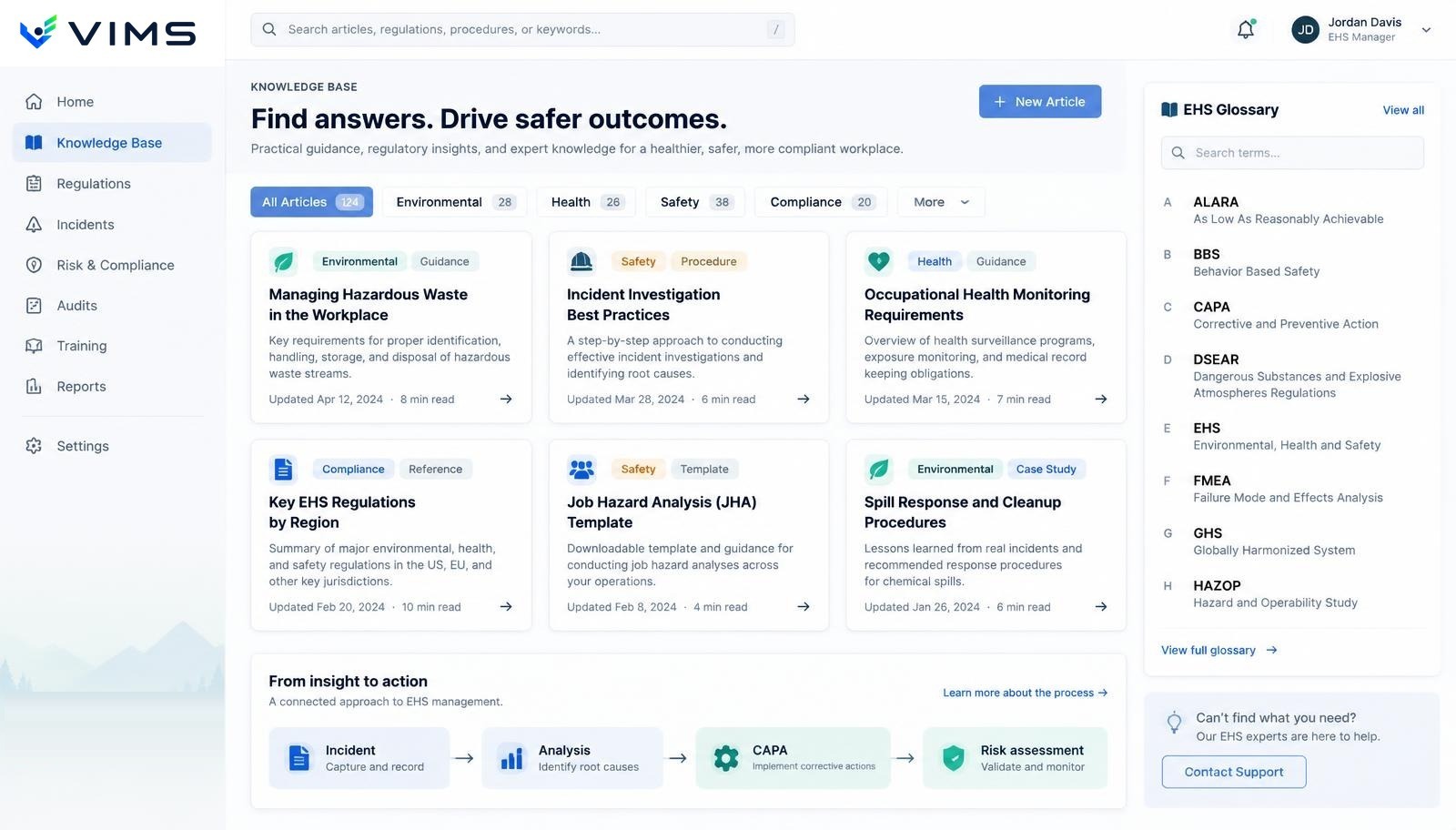
Chemical substance register and safety data sheets in the V-IMS system

The register: where to start the inventory

A register is built from three sources at once, and none of them is sufficient alone. The first is purchasing — every chemical line item from the last twelve months. The second is a walk through stores and workstations: the cans, drums and bottles physically present. The third is a conversation with supervisors about products bought ad hoc, outside the procedure.

Comparing those three lists almost always shows a gap. Substances bought once and untouched for years take up space and need disposal; substances in use but absent from purchasing records mean an informal supply route runs alongside the procedure.

For each entry, keep a minimum set: trade name, manufacturer or supplier, purpose, place of use and storage, approximate quantity, the date of the safety data sheet and a responsible person. That is enough to answer most inspection questions without opening a binder.

Which SDS sections matter operationally

The sheet has sixteen sections, but the shop floor works with five. Section 2 covers hazards and hazard statements — this is where you check whether the substance is carcinogenic, mutagenic, toxic for reproduction or a strong sensitiser, because that changes health surveillance and register requirements.

Section 4 is first aid, content that must be available immediately rather than after a call to the office. Section 7 covers storage and incompatibilities, answering what must not stand next to what. Section 8 gives limit values and required personal protective equipment, and section 13 covers waste and residues.

The practical consequence is that a worker does not need to read the whole sheet. They need an extract of those sections at the workstation, with the full sheet available on demand — for example after scanning a code on the rack.

Currency: how do you know a sheet is out of date

A sheet has no expiry date in the everyday sense, but it becomes outdated when the classification changes, the mixture composition changes, regulations change, or the supplier changes. The manufacturer must send an updated version to recipients, but in practice the new sheet lands in the purchasing inbox and stays there.

An effective mechanism is simple: at every delivery, the person receiving goods checks the sheet date and version on the packaging or documents against the version in the register. A mismatch creates a task for whoever owns chemicals.

The second mechanism is a periodic register review — quarterly for high-hazard substances, annually for the rest. The review also asks whether the substance is still used. Removing an entry matters as much as adding one.

Connecting chemicals to exposure and health surveillance

The chemical register is not a standalone document. Substance properties determine the scope of workplace exposure measurements, and those results shape the scope and frequency of health surveillance and the content of the risk assessment.

Introducing a new substance should therefore raise three questions automatically: does the measurement list change, does the health surveillance referral for people at that workstation change, and does the risk assessment need review. If only one person's memory asks those questions, sooner or later one will be missed.

The most common inspection findings on chemicals

The most common is straightforward: the sheet is in a binder in the office and unavailable at the workstation. The second is a substance standing in the hall and missing from the register. The third is decanting into an unlabelled container — a frequent and risky shortcut when diluting cleaning agents.

The fourth concerns storage: incompatible substances kept together, no spill containment, no ventilation. The fifth is inconsistency between the chemical register, the risk assessment and health surveillance referrals — three documents describing three different realities.

Chemical management checklist

  • The register was built from purchasing, a walkthrough and supervisor input, not a single source.
  • Every entry has a safety data sheet with a date and version.
  • An extract of sections 2, 4, 7, 8 and 13 is available at the workstation.
  • Goods receipt includes checking the sheet version.
  • Incompatible substances are separated in storage.
  • No products are kept in unlabelled containers.
  • A new substance triggers a review of measurements, health surveillance and risk assessment.
  • Withdrawn substances have been removed from the register and disposed of.

Frequently asked questions

Does the safety data sheet have to be on paper?

What matters is unrestricted access for the worker at the place and time the substance is used. Electronic access meets that if a device is available at the workstation and works during a network outage — so for areas without coverage, leave a printed extract.

What if the supplier does not send an updated sheet?

Request the sheet in writing and record the date of the request. Until the current version arrives, work on the latest one held and note that in the register — the correspondence trail is evidence of due diligence.

Does every substance require exposure measurements?

No. The scope follows the properties of the agent, how and how often it is used, and the conditions at the workstation. A substance used once a year in a closed system and the same substance sprayed daily are two different situations.

How often should the register be reviewed?

Quarterly for the highest-hazard substances and wherever the product range changes often; annually for a stable set. New entries are added as they appear, regardless of the review cycle.

Put chemicals into one register

We will show how V-IMS connects the substance register, safety data sheets, exposure measurements and health surveillance into one consistent path.