
VariloVIMS

Workplace measurements — results, exposure ratios and retest dates in one register

A measurement report usually goes into a binder and resurfaces at the next audit. Yet the result decides how often examinations are needed, what a referral must cover and what the risk assessment should say. This module turns a report into data you can use day to day.

  • Hazardous agent measurements
  • Exposure limits
  • Measurement points
  • Occupational exposure
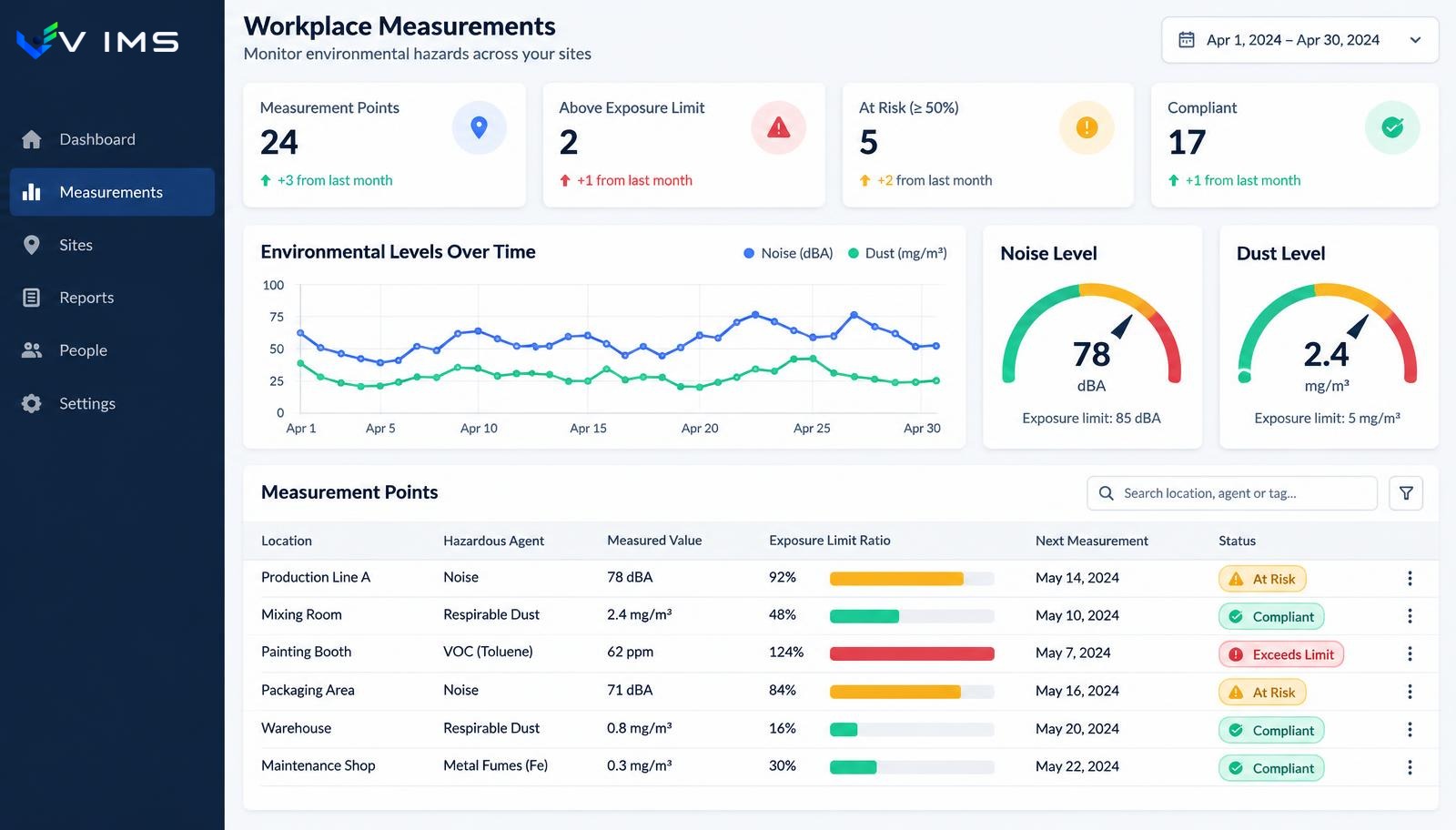
V-IMS — workplace measurement module showing measurement points with hazardous agent, measured value, exposure limit ratio, next measurement date and a trend chart of noise and dust levels

From a laboratory report to operational information

A result delivered as a PDF is a document, not information. To be useful it has to be broken down: measurement point, agent, measured value, reference value, ratio, date taken and date due. Only then can it answer the questions people actually ask on site.

Those questions are very concrete: where are we over the limit, which points are approaching it, which measurements expire this half-year and which workers are exposed to a given agent. None of them can be answered quickly by leafing through scanned reports.

In this module every measurement is a record tied to a location and an agent. A point's history shows a trend rather than a single value, so you can see whether the situation is improving or slowly deteriorating — and whether the engineering controls installed actually changed anything.

The exposure limit ratio as the primary indicator

An absolute value says little to anyone outside a laboratory. Eighty-two decibels sounds much like eighty-seven, although the situations differ considerably. The module's primary indicator is therefore the exposure limit ratio — the result expressed as a percentage of the limit.

That notation makes incomparable agents comparable: noise, dust, solvent and vibration land on one scale. A point at one hundred and twenty per cent demands action whatever it measures, and a point at ninety per cent is a warning even though it is formally compliant.

Thresholds are set by the organisation. A three-level scheme works well in practice — compliant, elevated, exceeded — because it matches three different responses: observation, planning, and immediate intervention.

Where measurements repeat every few years the classification has a further benefit: it produces an investment priority list based on numbers rather than impressions.

What the workplace measurement module gives you

Measurement points

Fixed locations linked to a hall, line, workplace and the agent measured there.

Exposure limit ratio

Each result set against its limit and expressed as an indicator comparable across agents.

Point history and trend

Successive measurements in one place, showing the direction of change after controls were applied.

Retest scheduling

The next measurement date calculated per point, with enough notice to order the service.

Link to chemicals

Substances from the SDS register set against real measurement results where they are used.

Exposure reporting

Breakdowns by area and agent, useful when updating the risk assessment and planning investment.

How a workplace measurement flows

The register closes the loop: a result drives an action, and the next measurement verifies it.

  1. 1Agents identified and measurement points defined
  2. 2Measurement ordered from an accredited laboratory
  3. 3Results entered and exposure ratios calculated
  4. 4Exceedances assessed and priority areas identified
  5. 5Engineering, organisational or PPE controls applied
  6. 6Follow-up measurement confirming effectiveness

Measurements that genuinely feed the risk assessment

A risk assessment describes exposure, but very often on the basis of data several years old, because nobody noticed a new report had arrived. A fresh measurement is one of the strongest pieces of evidence a safety team holds — and one of the least used day to day.

When results are records attached to locations, a change in exposure becomes an event rather than a file in a folder. Risk assessments for workplaces in that area can then be flagged for review before someone remembers them during an audit.

The same works in reverse: if a measurement after installing an acoustic enclosure shows a lower value, the effectiveness of that control has a numerical proof. That is the most persuasive material in any conversation about further spending.

Who is exposed, not only where it was measured

A measurement concerns a place, but risk concerns people. A useful register must therefore let you move from a measurement point to the list of people working in that area — across shifts, crews and contractors carrying out tasks there.

That step has direct administrative consequences. The scope of a preventive examination referral follows the factors present at the workplace, and a recorded exceedance may mean changing how often examinations are needed or widening what they cover.

The module is therefore designed as a link between three areas: measurements, risk assessment and occupational health. Each works on its own, but only together do they give a coherent picture of exposure.

One limit is worth keeping in mind: the register organises results and dates, while performing the measurements remains the job of an accredited laboratory.

Frequently asked questions about workplace measurements

Does the system perform measurements?

No. Measurements are carried out by an accredited laboratory. The module organises results, measurement points, ratios and dates, and links them to risk assessment and preventive examinations.

Which agents can be recorded?

The register is generic: noise, vibration, dust, chemicals, thermal conditions, lighting and other agents measured on site. Each stores a reference value alongside the result.

What is the exposure limit ratio?

The result expressed as a percentage of the applicable limit. It makes agents with different units comparable and allows one consistent set of warning thresholds.

Does the module remind about retests?

Yes. Each measurement point carries a next-measurement date, flagged early enough to order the service and arrange access to the area.

How do results affect the risk assessment?

A change in exposure signals a review of risk assessments for workplaces in that area, so the assessment rests on current data rather than a measurement from years ago.

Can you see who works in an area with an exceedance?

The register links a measurement point to an area and its workplaces, so you can move from the result to the people working there.

Related modules

VIMS module

Run risk assessment online: hazards, risk levels, control measures and reviews in one place, connected to what actually happens on site.

Risk assessment

VIMS module

One substance register, current safety data sheets available from a phone and full control over what is used where on site.

Chemicals and SDS

Medical examinations

An expired medical certificate means a worker cannot be allowed to work. With a hundred people a spreadsheet still copes. With several hundred, turnover and shift work you need a register that raises upcoming dates by itself.

Medical examinations

Turn measurement reports into a living exposure register

Book a demo and see measurement points, exposure ratios and reminders for upcoming retests.