

VIMS EHSVIMS EHS

Workplace exposure measurements — frequency, deadlines and record keeping

Testing and measuring harmful agents is an employer duty under Article 227 of the Polish Labour Code. The first measurements are due within 30 days of starting operations or changing a process, and later intervals depend on what fraction of the exposure limit (NDS or NDN) the last result reached.

This guide answers the procedural questions: when to measure first, how often to repeat, who may measure and which records to keep. Noise, vibration and dust limits are covered in a separate guide.

  • Exposure measurements
  • OEL
  • Noise limit
  • Harmful agents register
  • Measurement card

Published: 2026-10-26 · Updated: 2026-11-01 · 8 min read · Varilo deployment team

Workplace exposure measurements in a hall — sound level meter, dust sampler and vibration sensor with the next measurement schedule in VIMS EHS
Workplace exposure measurements in a hall — sound level meter, dust sampler and vibration sensor with the next measurement schedule in VIMS

1. When the first measurements are due

Short answer: within 30 days of starting operations. The duty arises again when equipment, technology, materials or work organisation change in a way that may alter exposure — a new machine, another substance or an extra shift.

Measurements are preceded by identifying the sources of harmful agents and the conditions affecting them. That survey is also the starting point for occupational risk assessment, so it is worth keeping it where the results will later be recorded.
2. How often to repeat — the OEL fraction rule

Short answer: the closer the last result was to the limit, the more often you measure. What counts is the ratio of the result to the NDS (chemicals and dust) or NDN (physical agents such as noise and vibration). Example: 82 dB against an 85 dB limit is above 0.5 NDN, so measurement is repeated at least once a year.

For carcinogens and mutagens the intervals are shorter — every 3 or 6 months. With very low results in two consecutive measurements the rules allow measurements to be discontinued, provided working conditions have not changed. Document such a decision with its justification.

3. Who may perform measurements

Measurements are performed by a laboratory accredited for the agent or one holding the required authorisation (e.g. State Sanitary Inspection units). A reading from your own meter is useful for routine checks but does not replace a test report.

When ordering, check the accreditation scope for the method, a measurement day representative of normal work, and whether the lab collects exposure-time data. These determine whether the result can be reliably compared with the limit.

4. Measurement cards, the harmful agents register and 40-year retention

Results go into the register of harmful agents and into measurement cards kept for each workstation. The register and cards are retained for 40 years after the last entry — on paper, an archive that must survive staff changes, moves and reorganisations.

Results must also be shared promptly with employees and passed to occupational health when referring workers for medical checks. Skipping this step is a common gap: the measurement was done but changed neither the risk assessment nor the referrals.

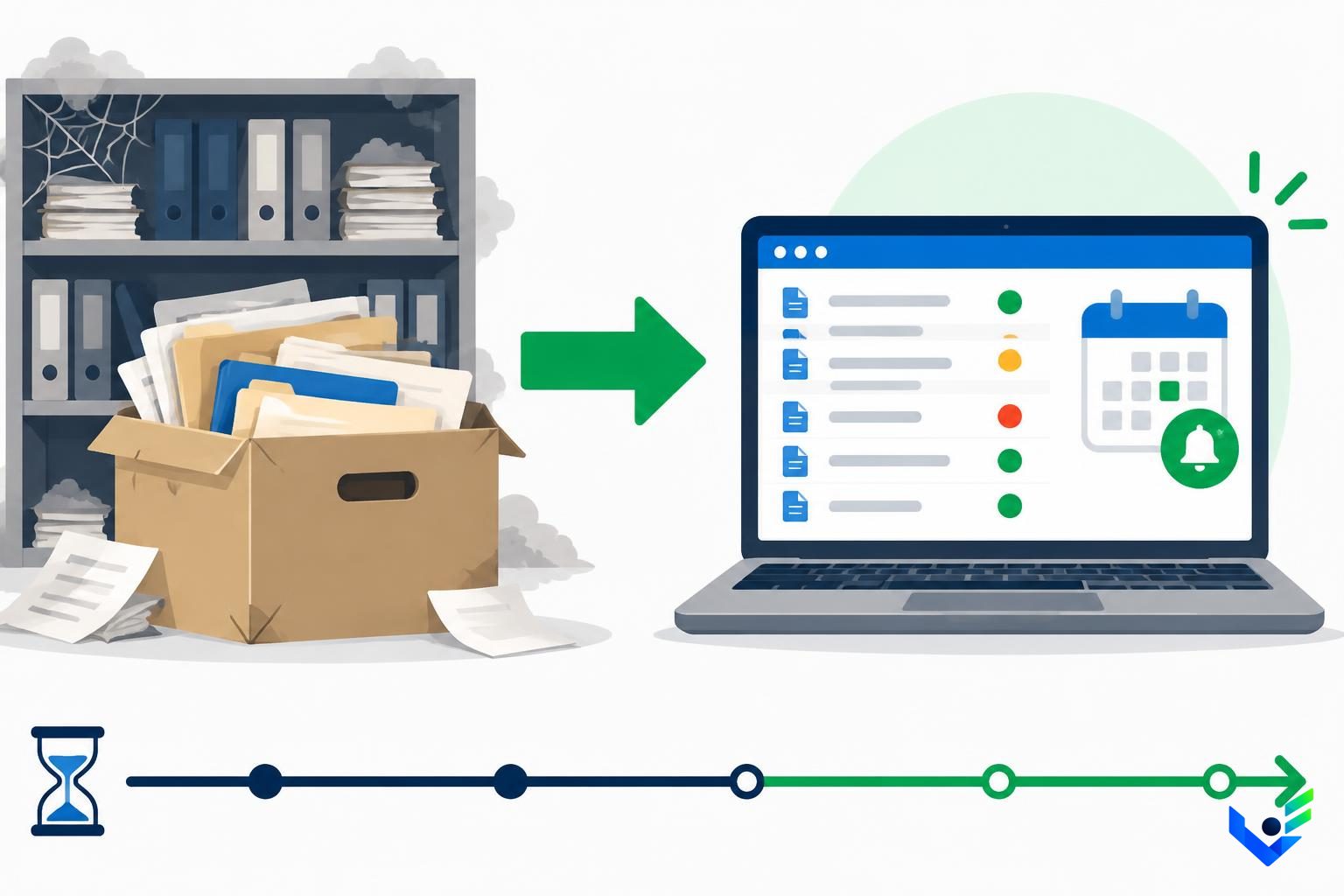
Harmful agents register — a paper archive kept for 40 years versus a digital measurement register with due-date reminders in VIMS EHS
A register kept for 40 years: paper archive versus digital measurement history with reminders (illustrative).

5. Glossary: measurement card, register, NDS, NDSCh and nuisance agents

The card of tests and measurements of harmful agents is kept for each workstation and holds successive results and their OEL fractions. The register of harmful agents in the working environment lists all agents and workstations in the plant. Both forms are set by the Polish Minister of Health regulation and kept for 40 years after the last entry.

NDS is the Polish 8-hour time-weighted occupational exposure limit (OEL), NDSCh the 15-minute short-term limit (STEL) and NDSP the ceiling value that must never be exceeded. NDN is the limit for physical agents such as noise, vibration and radiation. The OEL fraction — result divided by the limit — sets the next measurement date.

Carcinogens and mutagens (CMR substances) follow stricter rules: above 0.5 NDS every 3 months, 0.1–0.5 NDS every 6 months, plus a register of work and workers exposed. Chemicals are covered in the safety data sheet guide.

Harmful vs nuisance agents: electric lighting and moderate microclimate are not subject to the NDS/NDN interval system. Lighting is checked at commissioning, after changes and periodically under plant practice and EN 12464-1. Laboratories measuring harmful agents should hold PCA accreditation to EN ISO/IEC 17025 for the method concerned.

6. How VIMS keeps deadlines and puts results to use

In the Workplace exposure module each result is a record tied to a measurement point and agent. The system shows the OEL fraction, the point history and the next measurement date, so the service can be ordered in advance rather than after the deadline.

Results connect with the Occupational risk assessment module — the workstation card at that location is easy to flag for review — and with the Medical examinations module, where workstation agents drive referrals. Substances from the chemical substances and SDS register can be compared with measured results where they are used.

Measurement frequency by last result (Polish regulation)

Based on the Polish Minister of Health regulation on testing and measuring harmful agents. Always check the current consolidated text.

Agent typeLast resultMinimum frequency
Chemical or dust (non-carcinogenic)above 0.5 NDSat least once a year
Chemical or dust (non-carcinogenic)above 0.1 to 0.5 NDSat least every 2 years
Carcinogen or mutagenabove 0.5 NDSat least every 3 months
Carcinogen or mutagenabove 0.1 to 0.5 NDSat least every 6 months
Physical (e.g. noise, vibration)above 0.5 NDNat least once a year
Physical (e.g. noise, vibration)0.2 to 0.5 NDNat least every 2 years

Key takeaways

  • First measurements within 30 days of starting operations or a significant workstation change.
  • Frequency follows the OEL fraction of the last result, not a fixed cycle.
  • Only measurements by an accredited or authorised laboratory count.
  • Registers and cards are kept for 40 years; results must feed risk assessment and occupational health.

Frequently asked questions

How often should noise be measured?

At least once a year if the last result exceeded 0.5 NDN, and at least every 2 years for results between 0.2 and 0.5 NDN. After changes to machinery or work organisation, measure again.

Must a measurement be repeated immediately after an exceedance?

An exceedance first requires technical and organisational measures to reduce exposure. After implementing them, a measurement confirming effectiveness and a risk assessment update are advisable.

How long is the harmful agents register kept?

The register and measurement cards are kept for 40 years from the last entry.

Can the employer measure noise in-house?

Routine checks with your own meter are fine, but mandatory measurements are performed by an accredited or authorised laboratory.

Who receives measurement results?

Employees at the workstations concerned, promptly, and the occupational physician as the basis for medical referrals.

How often are carcinogens and mutagens (CMR) measured?

Above 0.5 NDS at least every 3 months; above 0.1 to 0.5 NDS at least every 6 months. A register of work and workers exposed to these substances is also kept.

Must lighting be measured every year like noise?

Not in the same way. Lighting is a nuisance agent rather than a harmful one, so OEL intervals do not apply. It is checked at commissioning, after changes and periodically under plant practice.

What is the difference between NDS, NDSCh and NDSP?

NDS is the 8-hour average limit, NDSCh the 15-minute short-term limit and NDSP a ceiling value never to be exceeded.

Track measurement deadlines without binders

See the VIMS Workplace exposure module: results, OEL fractions and next measurement dates linked to risk assessment and medical examinations.