
VIMS EHSVIMS EHS

Lone Working and Labour Law — Employer Duties and Supervision

Lone working is any work carried out without direct visual or voice contact with people who could help. Polish and most EU regulations do not ban it outright, but require the employer to assess the risk, provide supervision for particularly hazardous work and organise work so an injured person receives help quickly.

The most dangerous part of lone work is not the incident itself but the time that passes before anyone knows about it.

  • Lone working
  • Labour law
  • Hazardous work
  • Supervision

Published: 2026-10-19 · Updated: 2026-10-19 · 10 min read · Varilo deployment team

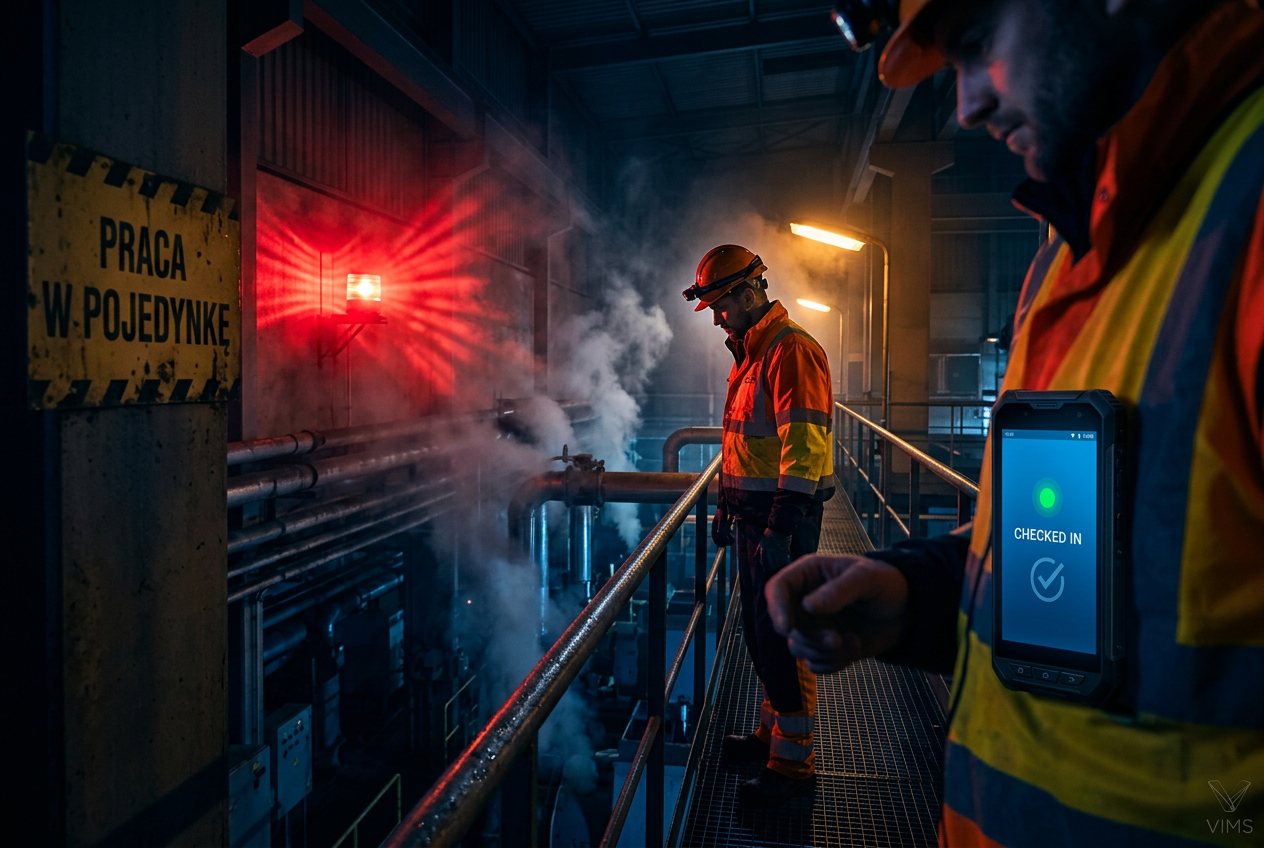
VIMS EHS — Worker in hi-vis alone on a catwalk in a pump hall with a smartphone showing a confirmed check-in and a lone work sign
Worker in hi-vis alone on a catwalk in a pump hall with a smartphone showing a confirmed check-in and a lone work sign

1. What the regulations say

The Polish Labour Code (Art. 207 § 2) requires the employer to protect workers' health and life by ensuring safe working conditions. Art. 225 covers particularly hazardous work: the employer must provide direct supervision by a designated person, suitable safeguards and instruction.

The general OHS regulation (§ 80–81) lists particularly hazardous work — confined spaces, work at height, live equipment, hazardous substances — and requires the employer to define detailed safety requirements, including, where necessary, at least two people. Specific rules (welding in tanks, excavations, power equipment) often require a second person explicitly. UK HSE guidance (INDG73) follows the same logic.
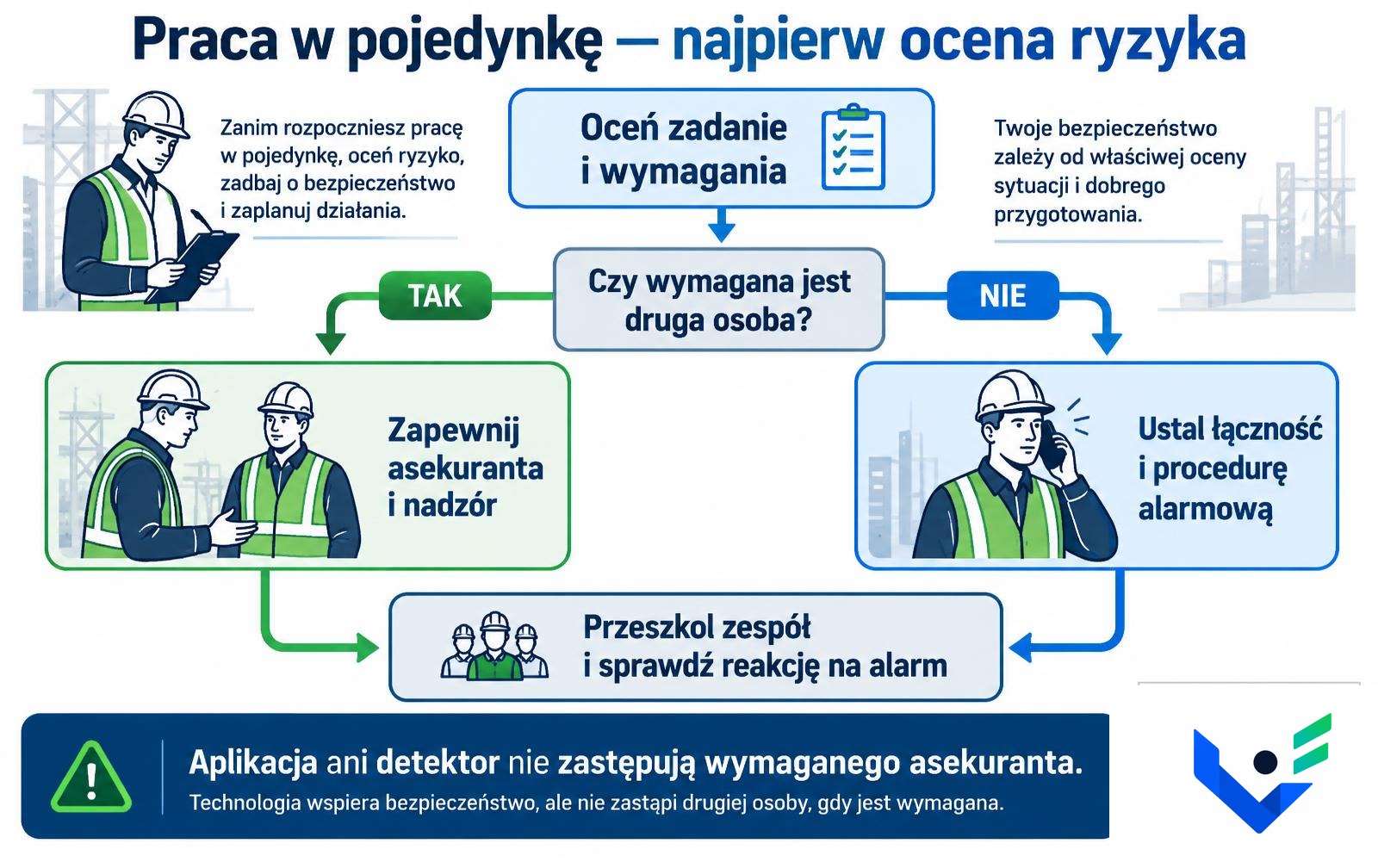
VIMS EHS diagram: lone working risk assessment, second-person requirement, standby support and supervision or communication and alarm procedure
VIMS — illustrative lone working decision tree (labels in Polish). An app or device does not replace a required standby person; assess requirements for each task.

2. When lone working is not acceptable

If the risk assessment or a specific rule requires a second person — entering a tank, working on open electrical equipment, work in a potentially explosive atmosphere with a required observer — no app or device replaces the standby person. Lone worker monitoring is a supplementary measure, not an exemption.

Good practice: state in the permit to work (PTW) whether the job may be done alone and which contact method applies.

3. When a worker may work alone — organising supervision

The risk assessment should include the lone-work factor: availability of help, responder travel time, connectivity, worker health and conditions (night, noise, height, chemicals). Measures follow: scheduled check-ins, SOS, fall or no-motion detection, a named responder and a response procedure.

Key control question: who will know, and how fast, that the worker needs help — and what will they do? If the answer is "someone notices they did not return at end of shift", there is no real supervision.

4. How VIMS Lone Worker helps

The worker starts a protection session in the Android app. During the session the app can raise an SOS, detect a possible fall or lack of movement and notify designated people and the dispatcher with the last known location or a QR/NFC zone. Every event is logged with acknowledgement time and response notes, helping document the measures applied.

The function is assistive: it does not guarantee a successful rescue and requires connectivity and a working phone. Always combine it with a response procedure and training.

5. Glossary: lone worker, supervision, prohibited lone work, response time

A lone worker is someone working without direct visual or verbal contact with colleagues who could help. Polish law has no single definition — the duty stems from Article 207 of the Labour Code (safe working conditions) and the occupational risk assessment; in the UK, HSE guidance INDG73 applies.

Supervision means ensuring the worker can call for help and that help arrives in an acceptable time — via a second person, scheduled check-ins, an alarm system or communication. Prohibited lone work typically includes confined spaces and tanks, supervised hot work and some electrical work — exact requirements come from sector regulations and must be confirmed for each task.

Response time is the period from an event (fall, SOS, missed check-in) to alarm acknowledgement and to help arriving. An escalation procedure defines who is notified first, when an alarm escalates (e.g. to a dispatcher or 112/999) and how the response is recorded — exactly what labour inspectors and ISO 45001 auditors check.

Lone working — quick qualification

SituationWorking aloneRequired measures
Warehouse round, night shiftAcceptable after risk assessmentCheck-ins, SOS, fall detection
Field service, travelAcceptableProtection session, location on alarm
Tank / confined space entryNot acceptableStandby person, PTW, gas testing
Work on live equipmentUsually not acceptablePer operating instruction and PTW

Key takeaways

  • Regulations do not ban lone working but require risk assessment and organised help.
  • Particularly hazardous work often requires at least two people.
  • A lone worker system shortens detection time but does not replace a standby person.
  • Document the measures: risk assessment, response procedure, alarm history.

Frequently asked questions

Must the employer provide a lone worker monitoring system?

Regulations do not mandate a specific technology. They require effective measures matched to the risk — an alarm system is one of them.

Who responds to an alarm?

The person or team named in the procedure — supervisor, dispatcher, security. They must be reachable throughout the lone work.

Are phone check-ins enough?

For low risk they can be. They will not detect loss of consciousness between calls — fall and no-motion detection covers that gap.

How often should a lone worker check in?

There is no single legal interval. It follows from the risk assessment — the higher the hazard and the longer help takes to arrive, the shorter it is; 15 to 60 minutes is common.

Can someone work alone on a night shift?

Yes, if the risk assessment allows it and supervision is in place: communication, check-ins or an alarm system and someone ready to respond. Work reserved for two or more people is the exception.

What should a lone working procedure include?

Permitted tasks, supervision measures, check-in interval, people responsible for response, escalation path, how emergency services are called and how alarms are recorded.

Protect people who work alone

Try VIMS Lone Worker: SOS, fall detection, notifications and incident history in one system.