VIMS EHSVIMS EHS

Occupational safety training in Poland — types, frequency and permitted forms

An employer may not allow anyone to work without induction safety training (Article 237³ of the Polish Labour Code), consisting of general and on-the-job instruction. Periodic training follows: the first within 12 months of hiring (6 months for managers), then every 1, 3, 5 or 6 years depending on the job group.

This guide sets out training types, intervals per job group and permitted forms, including e-learning. Finally, we show how to keep track of deadlines across dozens or hundreds of employees.

  • Induction training
  • Periodic safety training
  • On-the-job instruction
  • Safety e-learning
  • Training deadlines

Published: 2026-10-26 · Updated: 2026-11-01 · 8 min read · Varilo deployment team

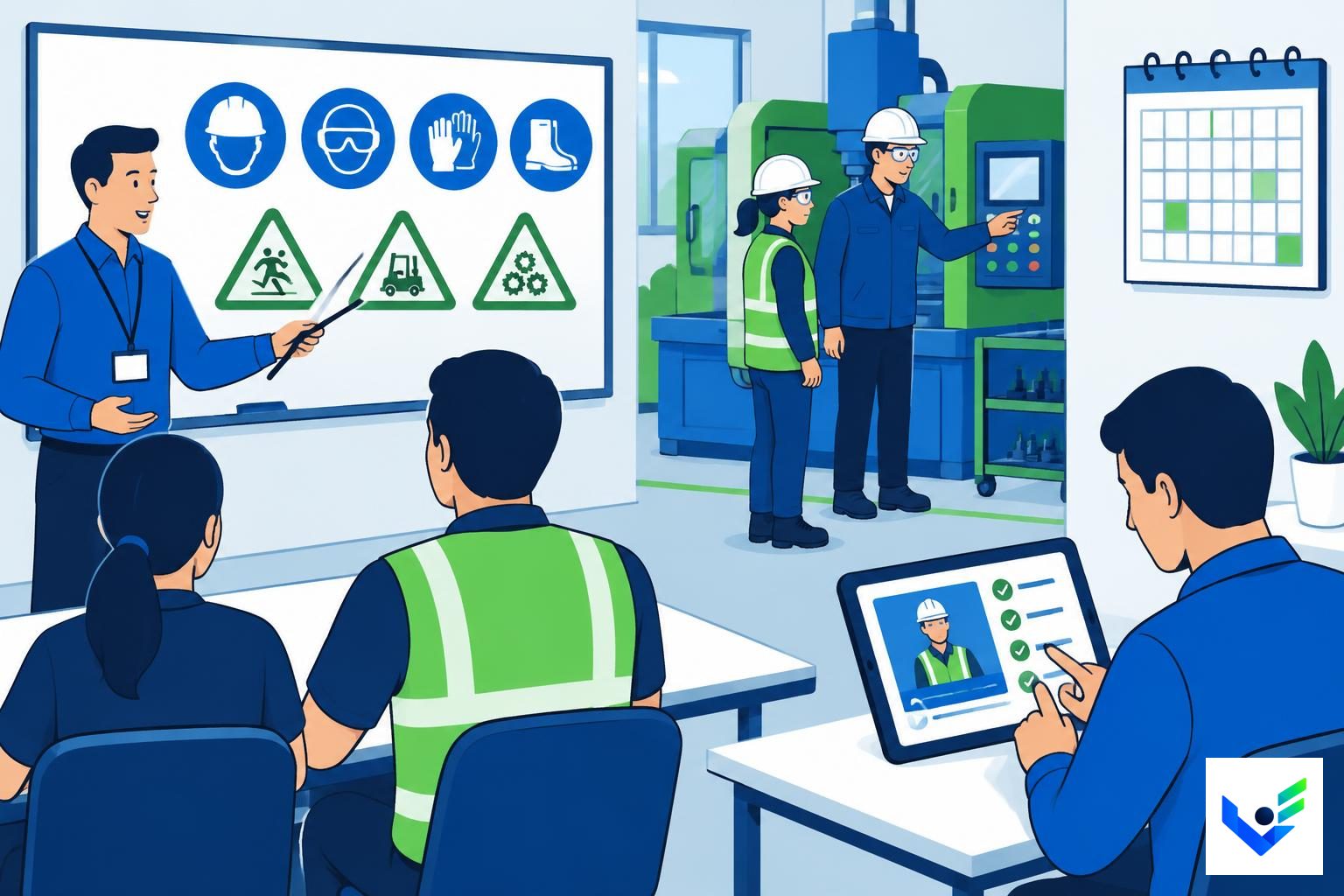
Safety training — general instruction at a board with safety signs, on-the-job instruction at a machine and e-learning on a tablet — VIMS EHS illustration
Safety training — general instruction at a board with safety signs, on-the-job instruction at a machine and e-learning on a tablet — VIMS illustration

1. Induction training: general and on-the-job instruction

Short answer: every new employee receives general instruction; on-the-job instruction is required mainly for manual workers, people exposed to hazardous agents, employees moving to a new workstation and trainees. General instruction covers basic rules, work regulations and first aid.

On-the-job instruction is usually given by the direct supervisor at the workstation, ends with a knowledge and skills check, and is based on the workstation's risk assessment. The employee confirms completion on the induction training card kept in the personnel file.

2. Periodic training: first session and later intervals

Short answer: the first periodic training takes place within 12 months of starting the job, or within 6 months for those managing staff (including employers). Later intervals depend on the group: manual workers every 3 years, or yearly for particularly hazardous work; managers, engineering staff and OSH services every 5 years; administrative and office staff every 6 years.

The interval runs from the completion date of the previous training. Valid periodic training completed with another employer may be recognised if it covers the same job group — document this in the file.

Safety training deadlines — a pile of certificates and sticky notes versus an employee list with training validity status and reminders in VIMS EHS
Certificates in binders versus a status list with reminders (illustrative).

3. Who can be exempt from periodic training

Administrative and office employees may be exempted from periodic training if the employer's risk assessment finds their work poses no hazards (Article 237³ § 2² of the Labour Code), except in cases set out in the rules. Small employers performing OSH tasks themselves still need valid training.

Such an exemption should follow a documented risk assessment. When duties or the workstation change, the decision must be reviewed — otherwise it loses its basis.

4. Training forms: course, seminar, guided self-study and e-learning

Short answer: periodic training may take the form of a course, seminar or guided self-study, including e-learning. The exception is manual workers: their periodic training must include practical instruction, which a video or online test alone cannot replace.

On-the-job instruction in induction training always takes place at the workstation. Every form ends with an exam and a certificate, a copy of which goes into the personnel file. The programme must reflect hazards in the specific plant, not just general rules.

5. How VIMS keeps training deadlines

In the Training and qualifications module each training record is assigned to an employee with completion and expiry dates. The list shows what is valid and what is expiring, so training groups can be planned ahead rather than discovering expired certificates during an inspection.

The Employees module links training to the workstation and Medical examinations to certificate validity, so both conditions for work are visible in one place. A change in the risk assessment signals a check of whether on-the-job instruction covers new hazards. VIMS EHS also includes an e-learning module: courses, materials, tests, progress records and certificates. Activation scope is confirmed during implementation; trainer requirements and permitted delivery formats must be checked for each training type.

6. Glossary: general and on-the-job instruction, induction training card, guided self-study

General instruction — the first part of induction training, given before work starts, usually by the OSH service. The framework programme sets at least 3 teaching hours (45 minutes each).

On-the-job instruction — the second part, given at the workstation by a person managing staff (supervisor, foreman) or the employer, who must be qualified, experienced and trained in instruction methods. Framework programmes set at least 8 teaching hours for manual workers and at least 2 for office roles. It ends with a knowledge and skills check.

Induction training card — the document confirming general and on-the-job instruction, signed by the employee and instructors, kept in part B of the personnel file together with periodic training certificates.

Guided self-study vs e-learning — guided self-study is the legal form defined in the regulation; e-learning is its technical variant. It does not replace on-the-job instruction or the practical component for manual workers.

Person managing staff — supervisors and managers have their own periodic training (first within 6 months, then every 5 years) and must ensure nobody starts work without on-the-job instruction.

Employer liability — allowing work without required training is an offence under Article 283 § 1 of the Labour Code (fine of PLN 1,000–30,000), and labour inspectors may order the employee removed from the work until trained. Tracking deadlines in the training and qualifications module reduces that risk.

Periodic safety training frequency (Polish regulation)

Based on the Polish regulation on occupational safety training. Always check the current text.

Job groupFirst periodic trainingSubsequent training
Manual workerswithin 12 months of hiringat least every 3 years
Manual workers on particularly hazardous workwithin 12 months of hiringat least once a year
Employers and staff managerswithin 6 months of startingat least every 5 years
Engineering and technical staff, OSH serviceswithin 12 months of hiringat least every 5 years
Administrative and office staffwithin 12 months of hiringat least every 6 years (exemption possible via risk assessment)

Key takeaways

  • No one may start work without induction training (general and on-the-job instruction).
  • First periodic training within 12 months, or 6 months for managers.
  • Subsequent training every 1, 3, 5 or 6 years depending on the job group.
  • E-learning is allowed, but manual workers need a practical component.

Frequently asked questions

How often is periodic safety training required?

Manual workers every 3 years (yearly for particularly hazardous work), managers and engineering staff every 5 years, administrative and office staff every 6 years.

When must the first periodic training take place?

Within 12 months of starting the job, or within 6 months for those managing staff.

Can safety training be done online?

Yes, periodic training may be guided self-study including e-learning. Manual workers still need practical instruction, and on-the-job instruction always takes place at the workstation.

Who pays for safety training?

The employer. Training takes place during working hours and at the employer's expense.

Do office workers need periodic training?

As a rule yes, every 6 years, but the employer may exempt them if the risk assessment shows their work poses no hazards.

Who may give on-the-job instruction?

A person managing staff appointed by the employer, or the employer, provided they have suitable qualifications and experience and have been trained in instruction methods.

Where are the induction card and periodic certificates kept?

In part B of the employee's personnel file. Scans can also be kept in a system to track validity, but the originals belong in the personnel records.

What is the penalty for letting someone work without safety training?

A fine of PLN 1,000–30,000 under Article 283 § 1 of the Labour Code, plus labour inspector orders. After an accident, missing training weighs heavily against the employer.

All training deadlines in one view

See the VIMS Training and qualifications module: training validity, deadline reminders and links to medical examinations.