
VIMS EHSVIMS EHS

Assessing energy expenditure at work — the Lehmann method, limits and protective meals

Energy expenditure is the energy a worker uses to perform work during a shift. In occupational safety it is expressed in kilojoules (kJ) as net expenditure — excluding basal metabolism — usually calculated with Lehmann's time-and-table (chronometric) method. Under Polish law the result determines, among other things, entitlement to protective meals, the physical-load element of the risk assessment and whether work is allowed for pregnant employees.

A step-by-step guide: how to time tasks, how to calculate expenditure from the tables, which thresholds Polish regulations use and how this differs from online calorie calculators (BMR, TDEE).

  • Lehmann method
  • Net energy expenditure
  • Protective meals
  • kJ per shift limits
  • Physical workload

Published: 2026-10-26 · Updated: 2026-11-01 · 9 min read · Varilo deployment team

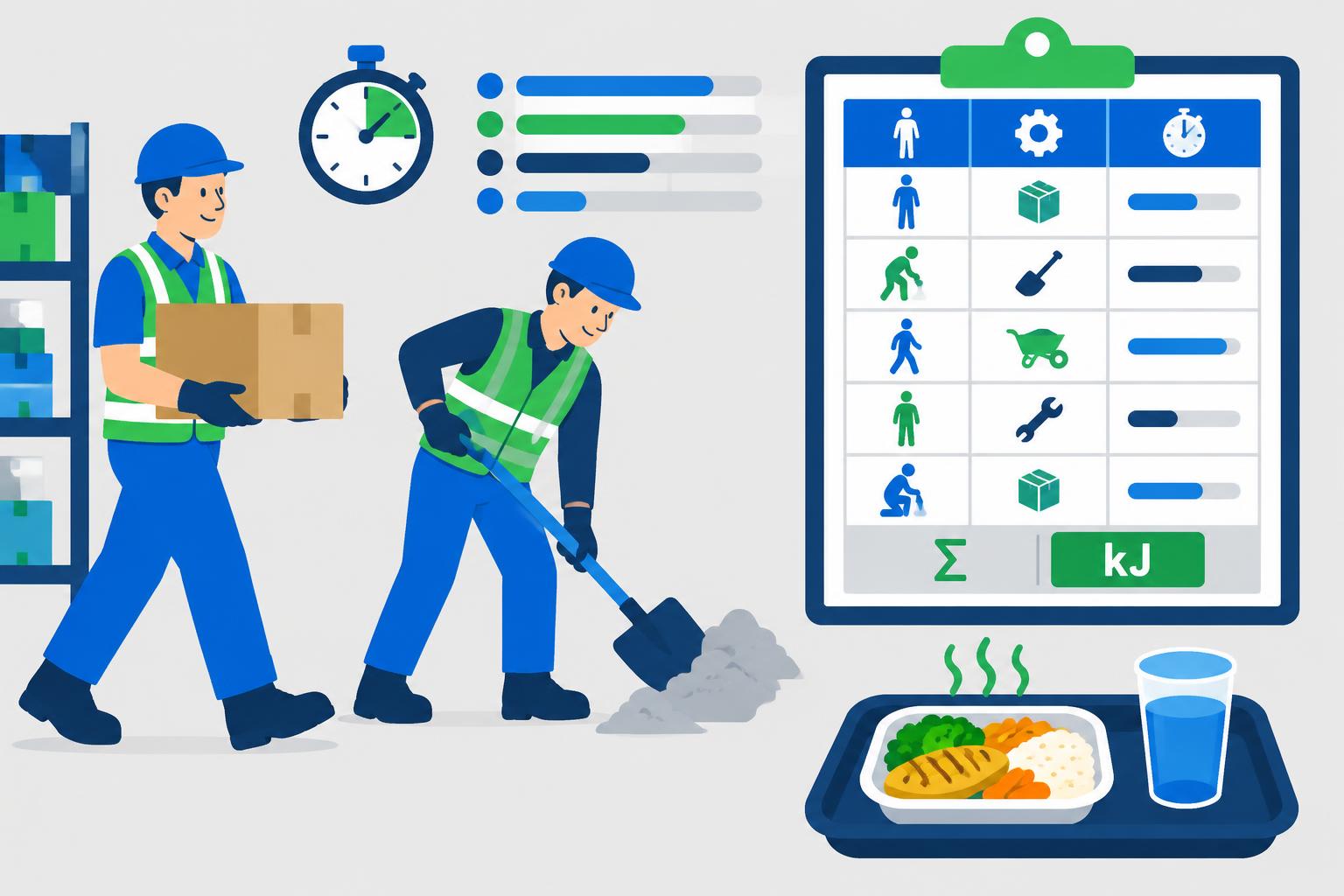
Energy expenditure assessment with the Lehmann method — workers doing physical work, task timing, a table summed in kJ and a protective meal — VIMS EHS illustration
Energy expenditure assessment with the Lehmann method — workers doing physical work, task timing, a table summed in kJ and a protective meal — VIMS illustration

1. Why assess energy expenditure

Short answer: you need it when work is physical — carrying loads, digging, awkward postures, outdoor work in winter. Without a figure in kJ it is hard to justify decisions on protective meals, on work assigned to pregnant employees or on the physical-load rating in the risk assessment.

The assessment is also evidence for the labour inspectorate, which will ask not only whether meals are provided but how eligibility was determined. Record the result with the date, task description and the person who did the timing.
2. Lehmann's time-and-table method — how to calculate

Short answer: split the shift into tasks, time each one, read the per-minute expenditure from Lehmann's tables for body posture, type of work (hands, one or both limbs, trunk) and any walking, multiply by minutes, sum in kcal and convert to kJ (1 kcal ≈ 4.19 kJ).

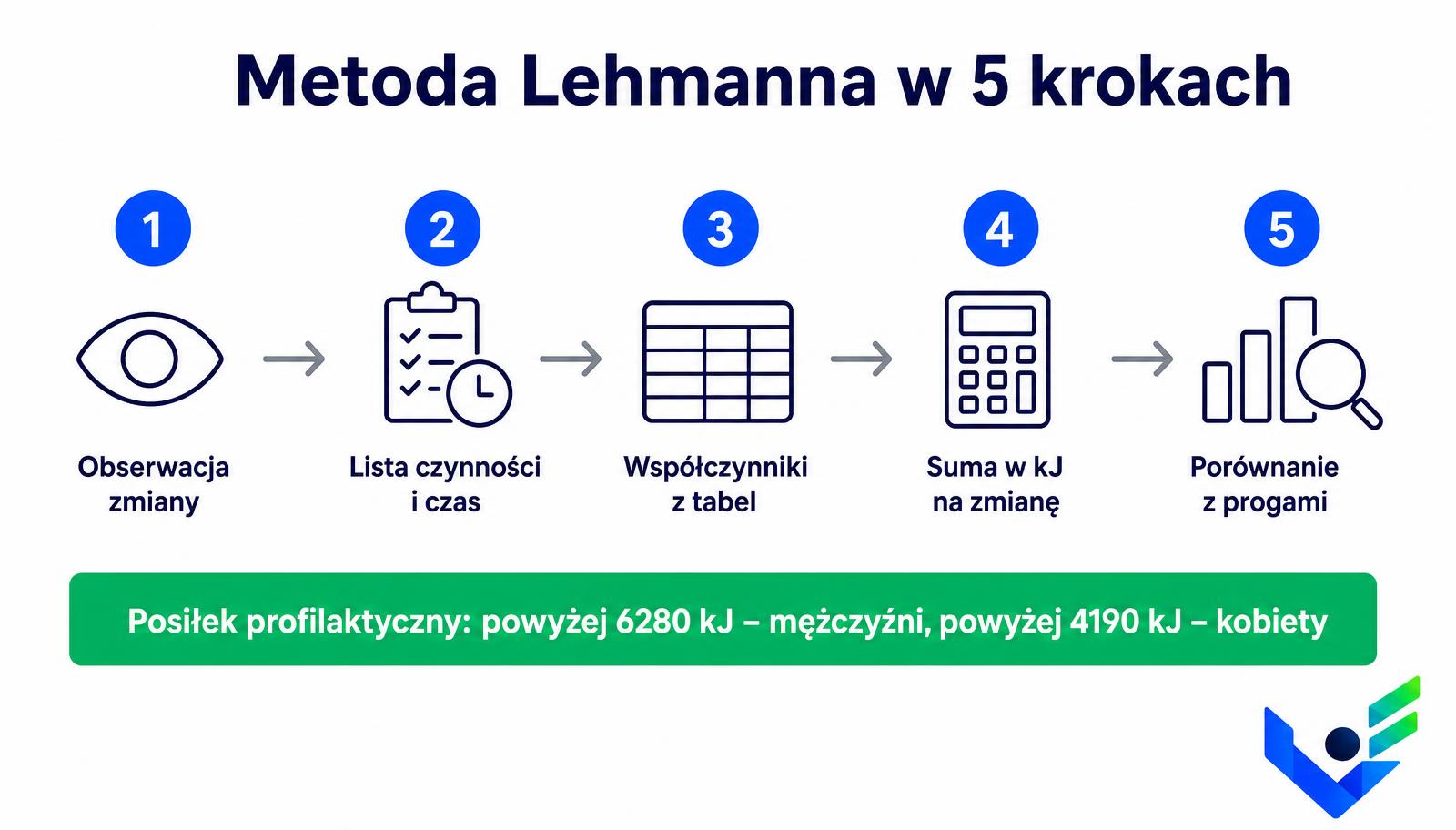
Step 1 — observe several typical shifts with the worker and supervisor. Step 2 — list tasks with durations in minutes, including breaks. Step 3 — pick coefficients from the tables; posture alone is roughly 0.3 kcal/min sitting, 0.6 kcal/min standing and 0.8 kcal/min bent over. Step 4 — sum for the shift. Step 5 — compare with regulatory thresholds.

Simplified example: a warehouse operative carries loads standing for 240 minutes, walks with a trolley for 120 minutes and does lighter scanner work for the rest. Each block is calculated separately; only the total shows whether a meal threshold is exceeded. A common mistake is rating the whole shift as heavy or ignoring breaks and idle time.

VIMS EHS infographic: the Lehmann method in 5 steps — shift observation, task timing, table coefficients, energy expenditure total in kJ and comparison with protective meal thresholds
Lehmann's time-and-table method step by step with the basic protective meal thresholds (labels in Polish).

3. Energy expenditure limits in Polish OSH law

Short answer: the manual handling regulation refers to net limits of about 8,400 kJ per shift for men and 5,000 kJ for women, with a lower threshold for pregnant employees in the list of prohibited work. Protective meals are due above about 6,280 kJ (1,500 kcal) per shift for men and 4,190 kJ (1,000 kcal) for women, with lower thresholds for outdoor work in winter.

Thresholds have changed through amendments and some apply only to specific work. Always check the current text of the regulations listed in the sources — the table in this guide is indicative.

4. Protective meals and drinks — how many calories and for whom

Short answer: a protective meal must be hot, served during a break and provide roughly 50–60% of daily energy needs. A cash allowance paid directly to the worker is not a valid substitute.

Drinks are provided separately, for example when working outdoors below 10°C or above 25°C, indoors above 28°C, or with high energy expenditure. The employer sets the list of eligible jobs after consulting employees — which is where a documented assessment helps.

5. Energy expenditure vs calorie calculators (BMR, TDEE, PAL)

Short answer: online calorie calculators (Mifflin–St Jeor, Harris–Benedict, PAL factor) estimate one person's total daily energy expenditure from age, weight and height. They are not suitable for workplace assessment, which needs the net expenditure of a specific job in kJ, based on task timing.

In practice, a TDEE calculator tells you how much a person should eat. The Lehmann method tells you whether the job is heavy enough to require a meal or a change in work organisation. Keep the two figures apart in your records.

6. Glossary: net expenditure, kJ, protective meals and cash equivalents

Net (effective) energy expenditure is the energy used for the work itself, excluding basal metabolism. Polish OSH rules express it in kilojoules (kJ) per shift; kilocalories are secondary (1 kcal ≈ 4.19 kJ). Diet-calculator calories do not belong in workstation records.

A protective meal is due for physical work above 6280 kJ (1500 kcal) for men and 4190 kJ (1000 kcal) for women per shift, and — in constant temperatures below 10°C, hot microclimates or outdoor work in winter (1 November – 31 March) — above about 4600 kJ (1100 kcal) for men and 2930 kJ (700 kcal) for women. Protective drinks are a separate entitlement depending on temperature and workload.

Cash equivalents: under Article 232 of the Polish Labour Code meals and drinks are provided free of charge, and the protective meals regulation does not provide for replacing them with money. Only the forms listed in the rules are allowed, such as a canteen or preparing meals from supplied products. Paying cash is a frequent labour inspection finding.

Pregnant and breastfeeding workers: the 2017 list of prohibited work bars pregnant women from work where net expenditure exceeds 2900 kJ per shift; separate limits apply to breastfeeding women. Record the Lehmann result in the occupational risk assessment so it is at hand when a pregnancy is reported.

7. Spreadsheet or managed records

Short answer: an Excel energy expenditure calculator is fine for the arithmetic, but poor at keeping the assessment current. It becomes outdated when technology, output norms, equipment or shift patterns change — and a spreadsheet will not remind you.

In VIMS you can attach the result and calculation sheet to the workstation in the Occupational Risk Assessment module as a physical-load factor, link it with the Workplace Exposure Measurements module and with eligible employees in the Employees module. When a job changes, it is easier to see that the assessment needs a review. VIMS organises the records — it does not replace the timing study itself.

Indicative energy expenditure thresholds per shift (Poland)

Indicative summary based on the regulations listed in the sources. Check the current wording before making decisions.

PurposeMenWomen
Protective meal — physical workabove approx. 6,280 kJ (1,500 kcal)above approx. 4,190 kJ (1,000 kcal)
Protective meal — outdoor work in winterabove approx. 4,600 kJ (1,100 kcal)above approx. 2,930 kJ (700 kcal)
Manual handling limitapprox. 8,400 kJapprox. 5,000 kJ
Pregnant employees—lower limit per the list of prohibited work

Key takeaways

  • OSH uses net expenditure in kJ per shift, not TDEE calories.
  • Lehmann method = task timing + table coefficients + total.
  • The result drives protective meals, work for pregnant employees and the risk assessment.
  • Repeat the assessment when technology, norms or work organisation change.

Related modules

Occupational risk assessment

Risk assessment — a living document instead of a binder

Run risk assessment online: hazards, risk levels, control measures and reviews in one place, connected to what actually happens on site.

Explore the VIMS EHS module: Occupational risk assessment with AI

Workplace exposure monitoring

Workplace measurements — results, exposure ratios and retest dates in one register

A measurement report usually goes into a binder and resurfaces at the next audit. Yet the result decides how often examinations are needed, what a referral must cover and what the risk assessment should say. This module turns a report into data you can use day to day.

Explore the VIMS EHS module: Work environment measurements

Employees and competence

Employees and competence — one record instead of ten separate name lists

The same people appear on the training list, in the examination schedule, in a risk assessment, on a work permit and in an accident report. If each of those lists lives its own life, sooner or later they stop agreeing. This module fixes the problem at the data level, not at the form level.

Explore the VIMS EHS module: Employee register

Medical examinations

Medical examinations — certificate validity tracked without paging through files

An expired medical certificate means a worker cannot be allowed to work. With a hundred people a spreadsheet still copes. With several hundred, turnover and shift work you need a register that raises upcoming dates by itself.

Explore the VIMS EHS module: Medical examinations with due-date reminders

Frequently asked questions

How do I calculate energy expenditure with the Lehmann method?

Split the shift into tasks, time each one, read per-minute values for posture, type of work and walking from the tables, multiply by minutes, sum and convert to kJ (1 kcal ≈ 4.19 kJ).

What expenditure qualifies for a protective meal in Poland?

Generally above about 1,500 kcal (6,280 kJ) per shift for men and 1,000 kcal (4,190 kJ) for women; thresholds are lower for outdoor work in winter.

Is there a limit for pregnant employees?

Yes, lower than for other women — set by the regulation listing work prohibited for pregnant or breastfeeding employees. Check the current value in the regulation.

Can I use an Excel calculator?

Yes, for the calculation — provided it uses Lehmann's tables and real timing data and is stored with the workstation assessment and next review date.

Can a TDEE calculator replace a workplace assessment?

No. These formulas estimate an individual's calorie needs, while the OSH assessment concerns the net expenditure of a specific job.

Can the employer pay cash instead of protective meals?

No. Protective meals and drinks are provided free of charge (Article 232 of the Polish Labour Code) and the rules do not allow replacing them with cash; only the forms listed in the regulation are permitted.

At what expenditure in kJ is a protective meal due?

For physical work above 6280 kJ (1500 kcal) per shift for men and 4190 kJ (1000 kcal) for women; in cold, hot microclimates or outdoor winter work the thresholds are lower — about 4600 kJ for men and 2930 kJ for women.

What energy expenditure is allowed for pregnant workers?

Under the Polish list of prohibited work, pregnant women may not perform work exceeding 2900 kJ net per shift. Separate limits apply to breastfeeding women — check the current text.

Workload assessments attached to the job, not a drawer

See the Occupational Risk Assessment module in VIMS: results and calculations linked to workstations, employees and review dates.